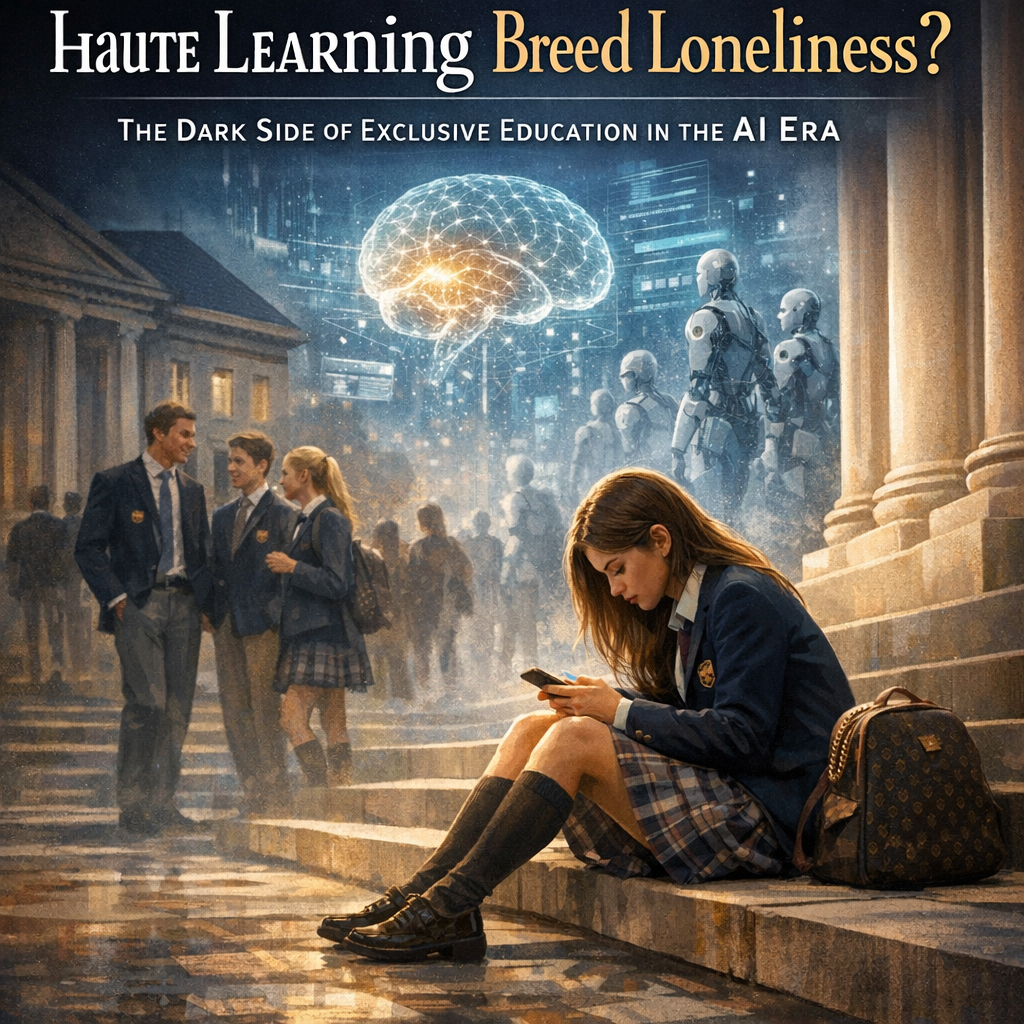
Does Haute Learning Breed Loneliness? The Dark Side of Exclusive Education in the AI Era
Introduction
In the glittering halls of elite educational institutions, where tuition fees match the price of luxury cars, parents of means often believe they have found the perfect springboard for their children’s success. These exclusive environments promise unparalleled learning opportunities, access to influential networks, and a preparation for a life of leadership. However, beneath the pristine surface of haute learning, there lurks a question that few dare to ask: Does this exclusivity come at the cost of connection? As the era of artificial intelligence (AI) redefines education, it seeds both unprecedented potential and unforeseen challenges, particularly the risk of heightened loneliness among students.
In the traditionally tight-knit settings of prestigious schools, individuals are groomed with a curriculum that often privileges individual achievement over collective growth. While AI-driven learning systems can personalize education like never before, adapting in real-time to a child’s unique needs, they may unwittingly reinforce this focus. Conversations between AI tutors and students lack the emotional subtleties of human interaction, potentially depriving children of developing crucial interpersonal skills and empathy.
Moreover, the cocooned world of exclusive education can isolate children from the broader, more diverse tapestry of society. Students in such environments may find themselves shielded from varied perspectives and unique challenges faced by their peers in more inclusive settings. The rise of AI in education, with its algorithmic efficiency and data-driven precision, risks creating echo chambers that mirror the homogeneity of privilege rather than celebrate diversity. The isolation from diverse perspectives can inhibit students’ ability to adapt to challenges outside their privileged bubbles, ultimately narrowing their worldview.
Additionally, the competitive atmosphere integral to these institutions may exacerbate feelings of loneliness. When success is measured through accolades, comparison becomes inevitable. In the AI era, where machines can effortlessly quantify performance, the pressure to excel intensifies, potentially alienating those who cannot keep up. For some students, the emphasis on individual success over group accomplishment might create emotional voids that are difficult to fill.
The discourse around the intersection of AI and education frequently highlights technological advancements, but the emotional and social implications are equally critical. As we navigate this brave new world, uncovering the potential pitfalls of haute learning remains crucial, for, at its core, true education enriches not just the mind, but the heart.
Features
Several studies suggest that the hyper-focus on individualized learning, amplified by AI, could contribute to a sense of isolation among students. According to research published by Stanford University, technology-mediated environments sometimes reduce the frequency and quality of face-to-face interactions—a critical component of social learning and emotional well-being. This study emphasizes that while technology can facilitate tailored educational experiences, it cannot replace the nuanced human connections necessary for developing empathy and collaborative skills.
Furthermore, a study by the University of California, Los Angeles (UCLA) explores the social impacts of technology in educational contexts. It reveals that students who spend more time engaged in digital environments often report higher levels of loneliness and lower self-esteem. These findings highlight the fact that immersive and individualized digital learning experiences, while beneficial in some respects, may inadvertently isolate students from their peers. The increased time spent in digital environments can detract from in-person experiences that are crucial for social development and self-esteem building.
Additionally, professional insights into the mental health of students attending selective institutions raise important concerns. The American Psychological Association (APA) has noted that students in competitive academic environments exhibit higher rates of stress and anxiety, factors that can lead to increased feelings of loneliness and isolation. When educational settings prioritize achievement above all else, students who struggle to meet these high standards may withdraw, diminishing their opportunities for meaningful social interaction.
Incorporating AI into education offers significant benefits, such as adaptive learning and enhanced resource accessibility, but these must be balanced with considerations for student well-being. A study by the Massachusetts Institute of Technology (MIT) even argues that while AI can present opportunities for personalized learning paths, integrating social-emotional learning (SEL) programs alongside technological advancements is crucial to address potential negatives like loneliness and social isolation. SEL programs can provide students with tools to build emotional resilience and empathy, which are necessary for thriving in both personal and professional settings.
Conclusion
The intersection of haute learning and AI presents a paradox where unparalleled educational opportunities could also breed a latent loneliness. While personalized education has its merits, the need for human connection and emotional intelligence remains irreplaceable. As we shape the future of education, integrating diverse, inclusive, and socially enriching experiences alongside technological advancements will be essential to creating not just successful individuals but fulfilled and empathetic human beings.
Ultimately, balancing the promises of exclusive, AI-driven education with the inherent need for human interaction and diversity will be key to addressing the nuanced challenges it presents. This delicate balance will ensure that we foster environments where students not only excel academically but also develop into well-rounded, compassionate individuals capable of contributing meaningfully to society.

Dominic E. is a passionate filmmaker navigating the exciting intersection of art and science. By day, he delves into the complexities of the human body as a full-time medical writer, meticulously translating intricate medical concepts into accessible and engaging narratives. By night, he explores the boundless realm of cinematic storytelling, crafting narratives that evoke emotion and challenge perspectives. Film Student and Full-time Medical Writer for ContentVendor.com