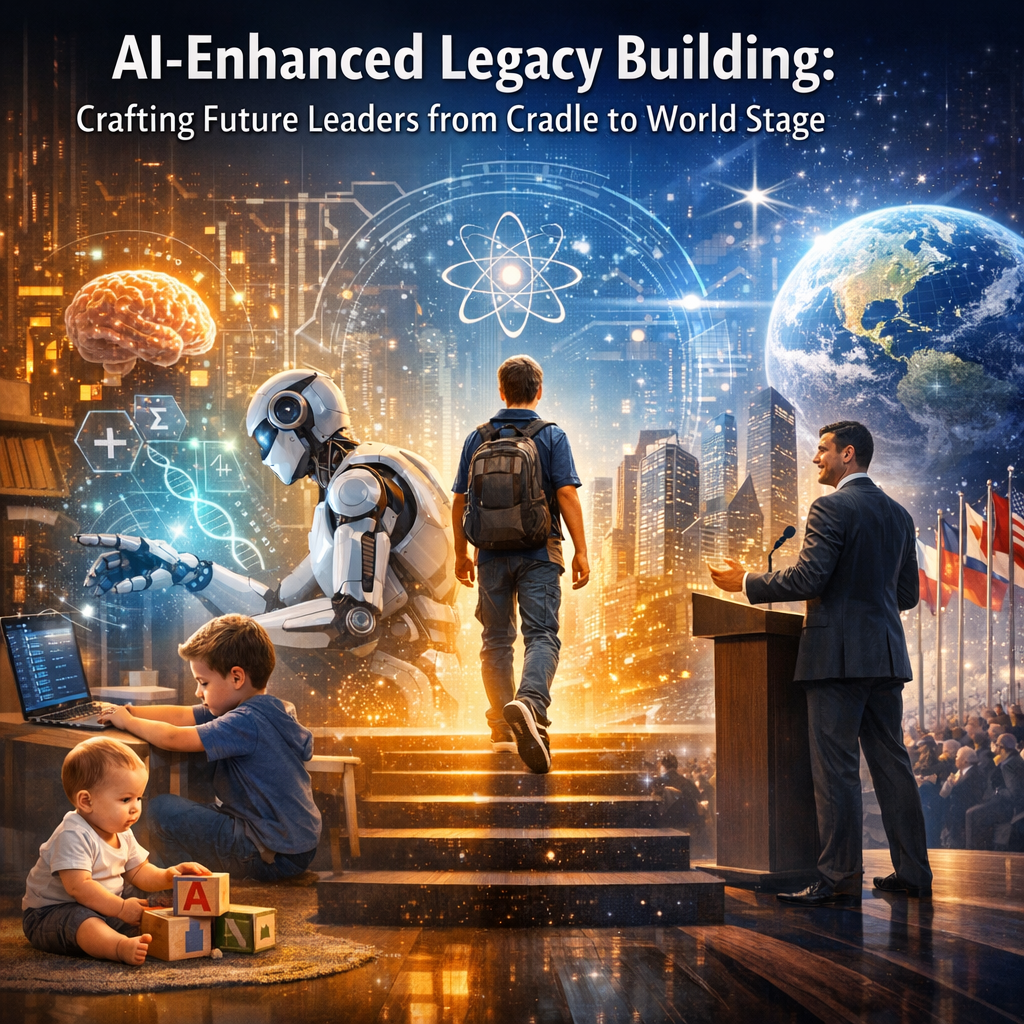
How AI Is Framing Tomorrow’s Child: Building the Future’s Most Capable Minds
In today’s rapidly evolving technological landscape, artificial intelligence (AI) is not just a tool; it is a transformer of possibilities. As AI continues to integrate into multiple aspects of daily life, its role in shaping the minds of the next generation is becoming increasingly significant. For parents who are keen on nurturing not just adequately educated children but extraordinarily capable ones, understanding the intersection between AI and child development is crucial. Our children are growing up alongside a technology that holds the potential to redefine learning and empowerment.
For parents of means, the question is not whether AI will influence your child’s future, but how you can best harness its power to elevate their developmental trajectory. With AI’s ability to deliver personalized learning experiences, adaptive play, and even emotional recognition, it opens doors that traditional methods could never unlock. Imagine a world where education is perfectly tailored to each child’s learning speed and style, where potential barriers like dyslexia or ADHD are skillfully managed with AI interventions, and where creativity is actively nurtured through intelligent systems designed for ideation and exploration.
Furthermore, AI doesn’t just prepare children for the future; it equips them with essential skills for the now. Cognitive abilities like problem-solving, critical thinking, and decision-making are amplified as AI-driven technologies offer environments rich with challenges and interactive learning. Meanwhile, social-emotional skills are nurtured through sophisticated algorithms capable of facilitating social understanding and empathy. This is not about replacing the role of parents or educators but enhancing it, providing them with more precise tools to mold young minds into leaders, thinkers, and innovators of tomorrow.
As we dive deeper into this fascinating arena, it is essential to discern which facets of AI application are genuinely effective. Fortunately, a multitude of studies are shedding light on this, providing evidence-based recommendations for utilizing AI in child development.
Features
Research has consistently highlighted the pivotal role of AI in educational settings. For instance, a 2020 study published by the [International Journal of Child-Computer Interaction](https://www.sciencedirect.com/science/article/abs/pii/S2212868919300574) explored the efficacy of adaptive learning technologies in enhancing children’s educational outcomes. The study showed that when AI systems are used to create adaptive learning environments, there is a significant improvement in students’ engagement and learning efficiency. Adaptive learning ensures that each child’s curriculum is automatically adjusted based on their learning pace and comprehension level, thus maximizing educational outcomes.
In addition to educational advancement, AI plays a supportive role in diagnosing and managing specific learning disabilities. The [Journal of Learning Disabilities](https://journals.sagepub.com/home/ldx) published a 2019 study where AI algorithms were employed to detect patterns indicative of dyslexia and ADHD with remarkable accuracy. By utilizing AI-driven assessments, educators and parents can obtain early and precise diagnoses, leading to timely interventions that can fundamentally alter a child’s educational pathway.
Beyond academics, AI also contributes to the development of emotional intelligence, a key predictor of future success. Tools like AI-based games and apps are crafted to support the development of social skills. Such technologies often include emotion recognition software that assists children in identifying and understanding emotional cues, an essential skill for personal and professional future success.
An exciting development in this field is the use of AI in creative education. A study published in [*Artificial Intelligence and Creativity*](https://www.journals.elsevier.com/artificial-intelligence) in 2021 found that AI tools help foster creativity by creating interactive platforms where children can ideate, experiment, and receive smart feedback. This encourages not only imaginative thinking but also resilience and innovative problem-solving skills.
Conclusion
As AI becomes more woven into the fabric of our children’s lives, the challenge and opportunity for parents lie in leveraging its capabilities judiciously. By understanding AI’s impact on education and emotional development, parents can ensure their children are not just passive consumers of technology but active, thoughtful participants in their own development and the world at large. With intentional use, AI is not just framing tomorrow’s child; it is building the future’s most capable minds. As we look to the future, the convergence of AI and child development offers a rich tapestry of possibilities, urging us all to envision and work toward a brighter, smarter tomorrow.

Dominic E. is a passionate filmmaker navigating the exciting intersection of art and science. By day, he delves into the complexities of the human body as a full-time medical writer, meticulously translating intricate medical concepts into accessible and engaging narratives. By night, he explores the boundless realm of cinematic storytelling, crafting narratives that evoke emotion and challenge perspectives. Film Student and Full-time Medical Writer for ContentVendor.com