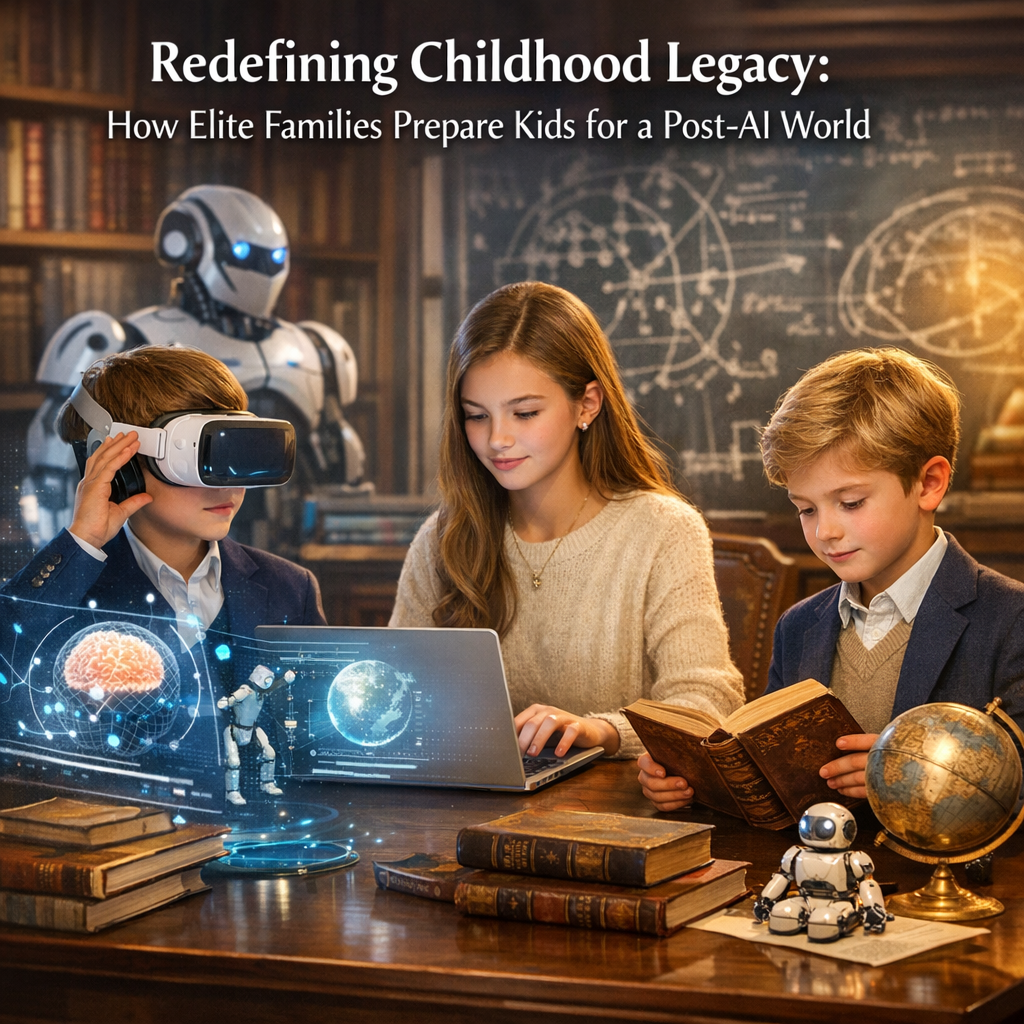
Redefining Childhood Legacy: How Elite Families Prepare Kids for a Post-AI World
Topic Introduction:
In the burgeoning era of Artificial Intelligence, the landscape of opportunity and risk is dramatically shifting, particularly for the younger generation. As AI continues to integrate with every aspect of society, from healthcare and finance to education and beyond, there has been a paradigm shift in how elite families perceive and prepare their children for the future. The focus is no longer solely on traditional markers of success such as prestigious universities or lucrative careers, but rather a holistic approach that redefines what it means to cultivate a childhood legacy in a post-AI world.
In the past, establishing a legacy often meant passing down wealth or a family name, but today, it involves equipping children with the cognitive flexibility, emotional intelligence, and ethical grounding to navigate an AI-driven world confidently. For elite families, this preparation is a multi-faceted endeavor that seeks to strike a balance between cultivating traditional skills and embracing new technologies and ideologies. This includes an emphasis on nurturing creativity, emotional intelligence, and adaptability—skills where humans naturally excel over machines.
Particularly in elite circles, there’s a growing trend to introduce children to coding and technological innovation at a young age. However, the truly transformative aspect of this preparation involves encouraging curiosity and fostering a growth mindset. Parents of means are investing in bespoke educational opportunities that go beyond conventional schooling. These include global cultural experiences, AI literacy workshops, and personalized mentoring systems aimed at building a passion for lifelong learning.
Elite families also take an introspective approach, encouraging their children to engage with ethical discourse surrounding AI technologies and their societal implications. By prioritizing ethical leadership development, these families ensure that future leaders understand the broad implications of AI, not just its economic or technological facets.
Features:
Recent studies underscore the importance of a well-rounded education in this new era. According to research published by the World Economic Forum, skills like creativity, collaboration, and emotional intelligence are becoming increasingly important as AI takes over more routine cognitive tasks. Furthermore, a report by the Pew Research Center outlines that while AI can process information faster than any human can, it lacks the nuance of human judgment, intuition, and emotional understanding—qualities that are crucial for leadership roles in the future.
Educational psychologists are also emphasizing the need for children to develop resilience and adaptability to thrive amidst technological advancements. A study from Harvard’s Graduate School of Education highlights how “grit” and a growth mindset can significantly impact a child’s ability to handle life’s challenges successfully.
These professional insights reveal that elite families are right to focus on nurturing a balanced intelligence in their children. They are increasingly investing in innovative learning programs that merge technology with the arts, ethics, and interpersonal skills. Institutions like the MIT Media Lab and Stanford’s d.school are offering programs that cater to this integrative approach, allowing students to experiment with AI while understanding its human impact.
Moreover, for elite families, providing children with real-world problem-solving skills through high-impact philanthropy and entrepreneurship opportunities is becoming essential. This exposure not only enhances practical and cognitive skills but also instills a sense of societal responsibility. By empowering their children to contribute positively to society, these families are fostering a legacy that transcends material wealth.
Conclusion:
As the influence of AI continues to expand, elite families are redefining what it means to prepare kids for the future by focusing on a comprehensive, adaptable, and ethically sound foundation. By nurturing creativity, ethical reasoning, and emotional intelligence alongside technological fluency, they are ensuring their children are not just participants but leaders in a post-AI world. It is this forward-thinking approach to legacy that will equip their offspring to thrive and make meaningful contributions amidst the evolving complexities of our digital age.
References:
1. [World Economic Forum](https://www.weforum.org/reports/the-future-of-jobs-report-2023)
2. [Pew Research Center](https://www.pewresearch.org/technology/)
3. [Harvard Graduate School of Education](https://www.gse.harvard.edu)

Dominic E. is a passionate filmmaker navigating the exciting intersection of art and science. By day, he delves into the complexities of the human body as a full-time medical writer, meticulously translating intricate medical concepts into accessible and engaging narratives. By night, he explores the boundless realm of cinematic storytelling, crafting narratives that evoke emotion and challenge perspectives. Film Student and Full-time Medical Writer for ContentVendor.com