Rethinking Elite Education: How Digital Nomad Families are Redefining Success in Childhood Development
Introduction
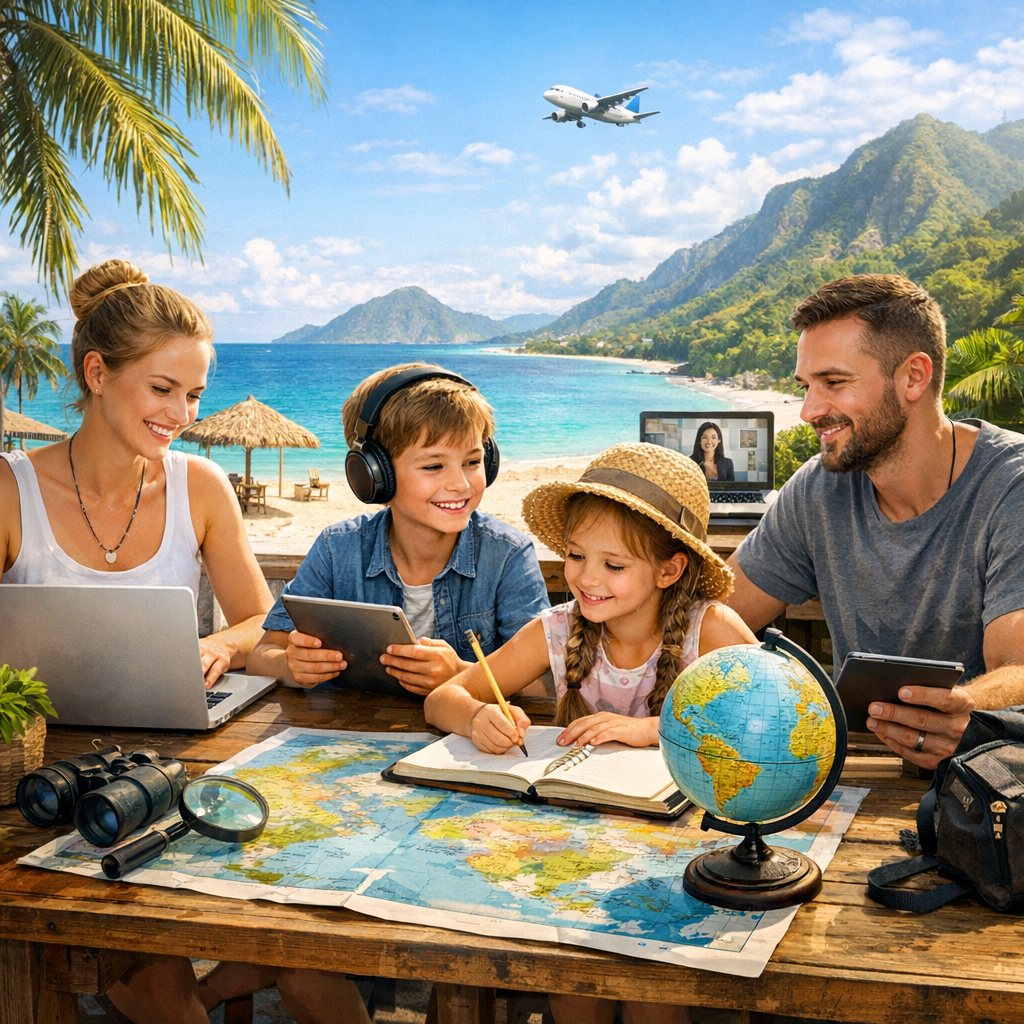
In an era defined by rapid technological advancements and a shift towards remote work, the traditional notions of education and success are being reexamined, particularly among families of means. The rise of digital nomadism has prompted well-to-do parents to reconsider how their children learn and develop in an increasingly interconnected world. These families are challenging the conventional education system, opting instead for a blend of worldschooling, experiential learning, and personalized curriculums tailored to their children’s unique interests and strengths. This emerging trend is fundamentally transforming the landscape of elite education, compelling us to rethink what success in childhood development truly means.
Historically, elite education has been synonymous with prestigious schools, rigorous academic programs, and a focus on preparing children for acceptance into top-tier universities. However, the conventional path is being questioned by digital nomad families who are questioning the efficacy of traditional schooling methods in nurturing the skills essential for the 21st century. In an age where creativity, adaptability, and global awareness are paramount, these families are embracing education models that extend beyond the confines of the classroom.
Digital nomad families are uniquely positioned to provide their children with a global education, immersing them in diverse cultures and languages, and offering a firsthand understanding of international issues. By doing so, they foster an education that prioritizes practical learning experiences and cultural competence, crucial assets for future leaders. Furthermore, this lifestyle allows for unparalleled parental involvement in the educational journey, enabling a tailored approach that supports individual learning styles and interests. This customization can cultivate a lifelong love for learning, as children engage with subjects they are passionate about.
Yet, this shift prompts important questions: Are digital nomad children missing out on the benefits of structured education environments? How do these unconventional educational paths impact social development and community building? As we explore the features of this new approach, backed by professional and medical studies, we investigate how digital nomadism is reshaping perceptions of success in childhood development.
Features
Several studies support the efficacy of experiential learning and its positive impact on childhood development. Research from the [University of Helsinki](https://www.helsinki.fi/en/research/experiential-learning-study) suggests that students engaged in experiential learning programs develop improved problem-solving skills, critical thinking, and a greater ability to adapt to new situations. These skills are increasingly valuable in a world that demands flexibility and innovation.
Moreover, digital nomad families provide their children with immersion in diverse cultures, fostering intercultural competence—a trait highlighted by the [American Psychological Association](https://www.apa.org/news/press/releases/intercultural-competence) as crucial for success in a globalized world. Children exposed to different languages and cultural contexts are often more empathetic and better equipped to navigate multicultural settings, as suggested by a study conducted by the [University of Toronto](https://www.utoronto.ca/research/bilingualism-cross-cultural-skills).
The involvement of parents in the educational process, as facilitated by the digital nomad lifestyle, is another factor contributing to the redefinition of success. According to a study published in the [Harvard Family Research Project](https://hfrp.org/publications-resources/impact-parental-involvement), active parental involvement in a child’s education is linked to higher academic achievement, improved social skills, and increased motivation. For digital nomad families, this involvement often extends beyond traditional “parent-teacher night,” resulting in enriched learning experiences.
Additionally, the opportunity for personalized and interest-driven learning is supported by educational psychologists. Research from [Stanford University](https://ed.stanford.edu/research/self-directed-learning) reveals that when children are given agency over their learning, they are more likely to develop intrinsic motivation and a deep-seated love for learning. This autonomy, characteristic of digital nomad education models, empowers children to pursue their passions and equips them with the confidence to tackle future challenges.
While the benefits are substantial, it’s important to consider potential drawbacks. Concerns regarding stability, access to consistent educational resources, and the opportunity for peer interactions remain relevant. However, many digital nomad families mitigate these issues by participating in online communities, educational co-ops, and structured programs that offer social engagement and academic support, illustrating how technology can bridge gaps in education traditionally offered by in-person schooling.
Conclusion
The digital nomad lifestyle offers a compelling alternative to traditional elite education, presenting children with opportunities for global learning and personalized growth while fostering crucial 21st-century skills. Though it may diverge from conventional paths, this education model emphasizes the importance of a well-rounded, adaptable, and culturally aware understanding of success in childhood development. As more families of means embrace this lifestyle, it reshapes the educational landscape, urging a broader reconsideration of what constitutes success for the leaders of tomorrow.

Dominic E. is a passionate filmmaker navigating the exciting intersection of art and science. By day, he delves into the complexities of the human body as a full-time medical writer, meticulously translating intricate medical concepts into accessible and engaging narratives. By night, he explores the boundless realm of cinematic storytelling, crafting narratives that evoke emotion and challenge perspectives. Film Student and Full-time Medical Writer for ContentVendor.com