AI Parenting: Why Your Child’s First Robot Friend Could Be a Coder’s Dream
Introduction:
In today’s rapidly evolving technological landscape, children are growing up surrounded by an array of digital devices and intelligent technologies. Among these innovations, artificial intelligence (AI) emerges as a transformative force, reshaping the way young minds interact with the world around them. While video games and educational apps have long been staples in children’s digital lives, the introduction of AI-powered robots presents an opportunity for a new kind of interaction—one that combines play with learning in an unprecedented manner.
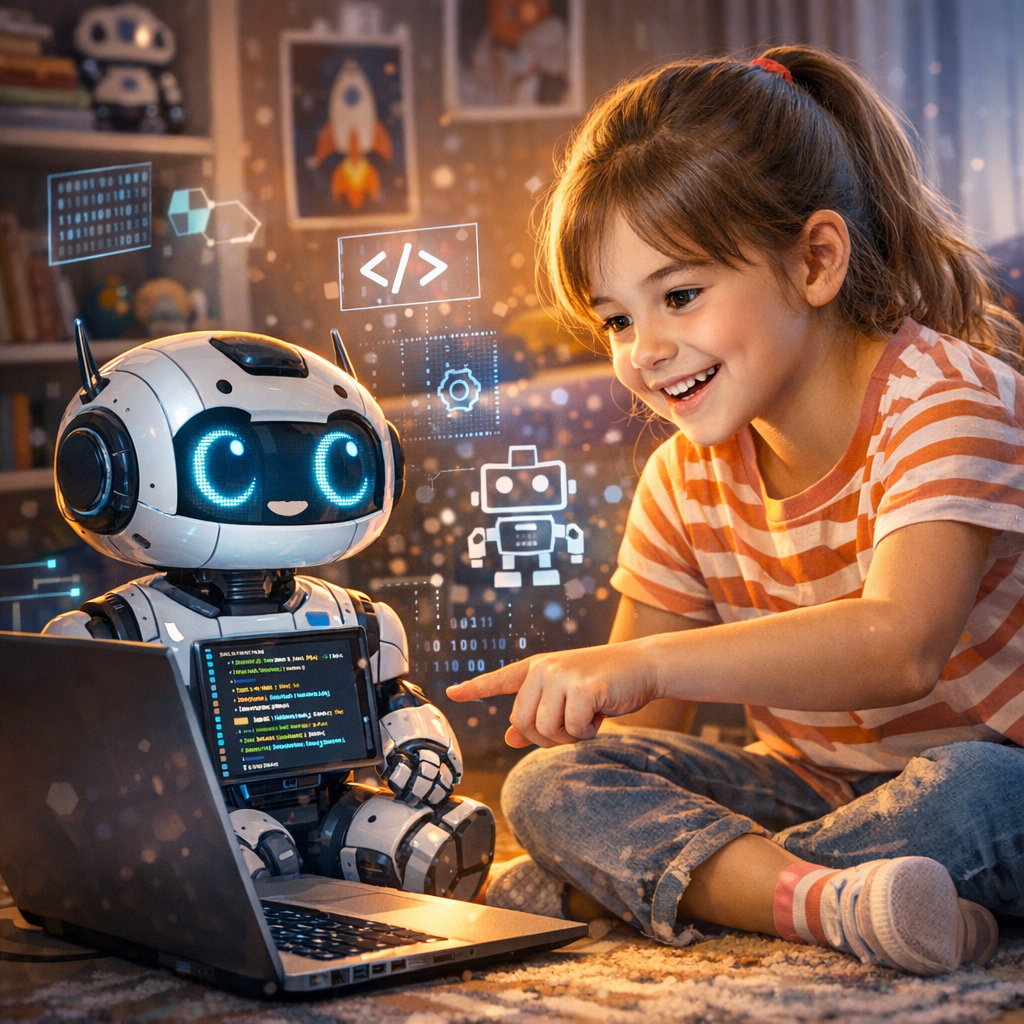
Imagine a world where your child’s best friend is not merely a talking robot but a versatile tool capable of facilitating powerful educational experiences. These AI companions are more than just animatronic toys; they are platforms for fostering creativity, critical thinking, and advanced problem-solving skills. From automating tedious tasks to offering personalized learning experiences, these robots open doors to new educational paradigms that previous generations could only dream about.
Embracing AI in early childhood education is not just about preparing children for the jobs of the future—many of which may not yet exist—but also about nurturing the cognitive and emotional skills necessary to navigate a world dominated by technology. Today, robots like Cozmo, Miko, and Pleo are designed not only to entertain but to serve as educational companions that engage children’s imaginations while teaching core concepts of coding and digital literacy. As parents, investing in an AI companion for your child can help bridge the gap between passive screen time and active learning.
Consequently, understanding how these AI friends can positively influence your child’s development is essential. This article delves into the profound impact that robotic companions can have on a child’s educational journey, supported by meaningful studies and expert insights, making a compelling case for why your child’s first robot friend could indeed be a coder’s dream.
Features:
Evidence supporting the educational advantages of AI companions is accumulating, with various professional and academic studies highlighting their potential benefits. A significant study conducted by the [Massachusetts Institute of Technology](http://web.media.mit.edu/~cynthia/2000-2005.html) (MIT) found that children who interacted with AI-powered robots developed enhanced problem-solving abilities and were more receptive to learning complex subjects such as programming and robotics. The study emphasized that robots could serve as effective educational tools, providing dynamic and personalized learning experiences that adapt to each child’s unique learning pace and style.
Furthermore, a report by the [World Economic Forum](https://www.weforum.org/agenda/2018/09/4-ways-ai-is-changing-the-face-of-education/) detailed the impact of AI on education, indicating that AI’s role in developing digital intelligence is fundamental to children’s education in the 21st century. The report noted that educational robots could help demystify complex technological concepts early on, making learning processes more intuitive and engaging for young children.
On a psychological level, interactions with AI companions have also been shown to foster social and emotional development. Research published in the [Journal of Human-Robot Interaction](https://humanrobotinteraction.org/journal/index.php/HRI/article/view/28) detailed how children form emotional bonds with their robotic friends, which can enhance empathy, social skills, and collaborative abilities when working with peers. This social engagement can be particularly beneficial to children who may struggle with traditional forms of socialization or those on the autism spectrum.
A notable feature of these AI companions is their ability to introduce the principles of coding in a manner accessible to young children. Many robots come equipped with user-friendly interfaces that simplify coding concepts, allowing kids to experiment with programming through trial and error while receiving immediate feedback. This hands-on experience supports a child’s capacity to understand and implement abstract ideas, setting a foundation for future proficiency in STEM (science, technology, engineering, and mathematics) fields.
Conclusion:
As we navigate the intricacies of 21st-century parenting, integrating AI companions into our children’s lives offers a harmonious synergy of play and learning that is both innovative and essential. These robotic friends pivot the educational focus from passive to interactive, nurturing the foundational skills that will empower children to thrive in a technologically advanced world. By embracing this technology early on, parents can foster a generation of problem solvers, creators, and lifelong learners—truly a coder’s dream realized.
References:
1. [MIT Study on Child-Robot Interaction](http://web.media.mit.edu/~cynthia/2000-2005.html)
2. [World Economic Forum – The Role of AI in Education](https://www.weforum.org/agenda/2018/09/4-ways-ai-is-changing-the-face-of-education/)
3. [Journal of Human-Robot Interaction](https://humanrobotinteraction.org/journal/index.php/HRI/article/view/28)

Dominic E. is a passionate filmmaker navigating the exciting intersection of art and science. By day, he delves into the complexities of the human body as a full-time medical writer, meticulously translating intricate medical concepts into accessible and engaging narratives. By night, he explores the boundless realm of cinematic storytelling, crafting narratives that evoke emotion and challenge perspectives. Film Student and Full-time Medical Writer for ContentVendor.com