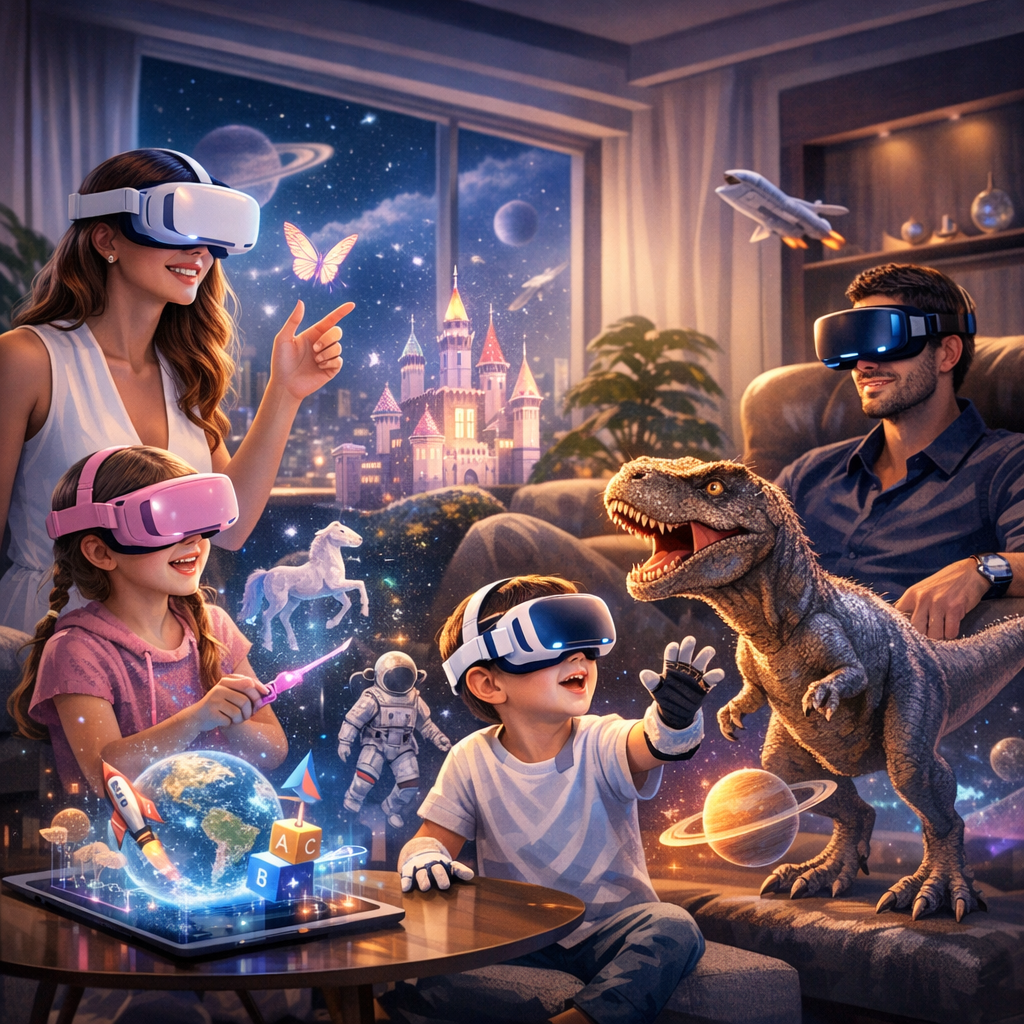
“`html
Luxury Parenting in the Metaverse: How Virtual Reality is Revolutionizing Child Development
Introduction
In the ever-evolving landscape of technology, the metaverse and virtual reality are not distant prospects but rather an imminent reality, deeply intertwining with our daily lives. For parents of means who perpetually seek the pinnacle of educational and developmental experiences for their children, the integration of virtual reality (VR) into parenting opens up a plethora of innovative opportunities. Long gone are the days when technology was just an accessory in child development; it is now a cornerstone. Virtual reality, with its immersive and interactive capabilities, stands at the forefront of this paradigm shift, offering new vistas in education, creativity, and cognitive development.
VR technology has seen unprecedented growth, evolving from rudimentary designs to sophisticated, lifelike simulations. The metaverse, a collective virtual shared space, is spearheading this evolution, providing children unparalleled access to a world of interactive learning and exploration. Imagine your child walking through the sands of ancient Egypt, witnessing the grandeur of the pyramids, or exploring the microscopic wonders of the human body—all from the comfort of your home. Such experiences are not mere enhancements of traditional learning; they are revolutionary transformations.
For affluent parents, investing in VR technology is more than an indulgence—it is an investment in their children’s future. The immersive nature of VR facilitates experiential learning, which is known to bolster understanding and retention. Experts suggest that children learn best through direct interaction and exploration, and VR offers precisely that, with minimal risk and maximum engagement. Moreover, as global citizens in a digital world, children versed in VR technology will possess significant social and cognitive advantages.
Furthermore, luxury parenting in the metaverse extends beyond academic achievement. It encompasses broadening horizons, fostering empathy, and encouraging creativity. With VR, children can interact globally, experiencing diverse cultures and narratives, thereby cultivating a generation that is not only intelligent but also empathetic and socially aware.
Features
Recent studies and professional insights underscore the transformative potential of VR in child development. According to a study published in the [Journal of Educational Psychology](https://psycnet.apa.org/record/2021-25039-001), virtual reality can significantly enhance cognitive development and problem-solving skills in children. The research highlights that the immersive nature of VR stimulates brain areas associated with spatial awareness, memory retention, and emotional responses, leading to a more holistic form of learning.
Additionally, the [Carnegie Mellon University’s Human-Computer Interaction Institute](https://www.cs.cmu.edu/~cfrieze/VR_EDU.pdf) demonstrates VR’s potential in developing social and emotional skills. Through simulations that require empathy and decision-making, VR encourages children to understand perspectives different from their own, which is a crucial life skill.
From a medical standpoint, professionals argue that VR can aid children with special needs, offering customized, controlled environments conducive to specific therapeutic goals. The use of [VR in therapy for children with autism](https://www.autism.org.uk/advice-and-guidance/professional-practice/vr-in-autism) has shown promising results, allowing these children to rehearse social behaviors in a safe, repeatable setting. Moreover, VR-based learning can be tailored to suit individual learning styles, ensuring that children receive personalized education experiences.
Such technological integration also promotes digital literacy from a young age. As children navigate complex virtual environments, they develop critical digital skills, preparing them for future careers in an inexorably digital world. This aligns seamlessly with luxury parenting ideologies, where the objective is to provide children not just with opulence, but with tools and experiences that equip them for future success.
Conclusion
In conclusion, the integration of virtual reality into child development offers unprecedented opportunities for luxury parenting, shaping a future generation of perceptive, informed, and socially conscious individuals. As the metaverse continues to expand, the potential of VR to revolutionize education is immense, making it a vital component of modern parenting strategies. Parents delving into this brave new world are not only providing their children with opulent present experiences but are also paving the way for a future rich in skills and perspective.
References
1. [Journal of Educational Psychology](https://psycnet.apa.org/record/2021-25039-001)
2. [Carnegie Mellon University’s Human-Computer Interaction Institute](https://www.cs.cmu.edu/~cfrieze/VR_EDU.pdf)
3. [National Autistic Society](https://www.autism.org.uk/advice-and-guidance/professional-practice/vr-in-autism)
“`

Dominic E. is a passionate filmmaker navigating the exciting intersection of art and science. By day, he delves into the complexities of the human body as a full-time medical writer, meticulously translating intricate medical concepts into accessible and engaging narratives. By night, he explores the boundless realm of cinematic storytelling, crafting narratives that evoke emotion and challenge perspectives. Film Student and Full-time Medical Writer for ContentVendor.com