“`html
Unleashing the Future: How AI Is Transforming Parenting into a Strategic Advantage
Introduction
In an era where technology continuously reshapes our lives, artificial intelligence (AI) stands at the forefront, influencing countless facets of human experience, from commerce and communication to healthcare and entertainment. Among the most compelling and impactful transformations is AI’s burgeoning role in parenting. For parents of means, particularly those who manage dynamic careers alongside familial responsibilities, AI offers a strategic advantage by enhancing their ability to maintain the delicate balance of nurturing and guiding their children while pursuing personal and professional ambitions.
Parenting has always been a complex journey, imbued with both immense joy and significant challenges. Every stage, from infancy to adolescence, demands careful attention and informed decision-making. Historically, parents relied on a limited toolkit comprising personal experience, ancestral wisdom, and popular parenting guides. Today, AI introduces an entirely new spectrum of tools that enable parents to engage more deeply and meaningfully with their children.
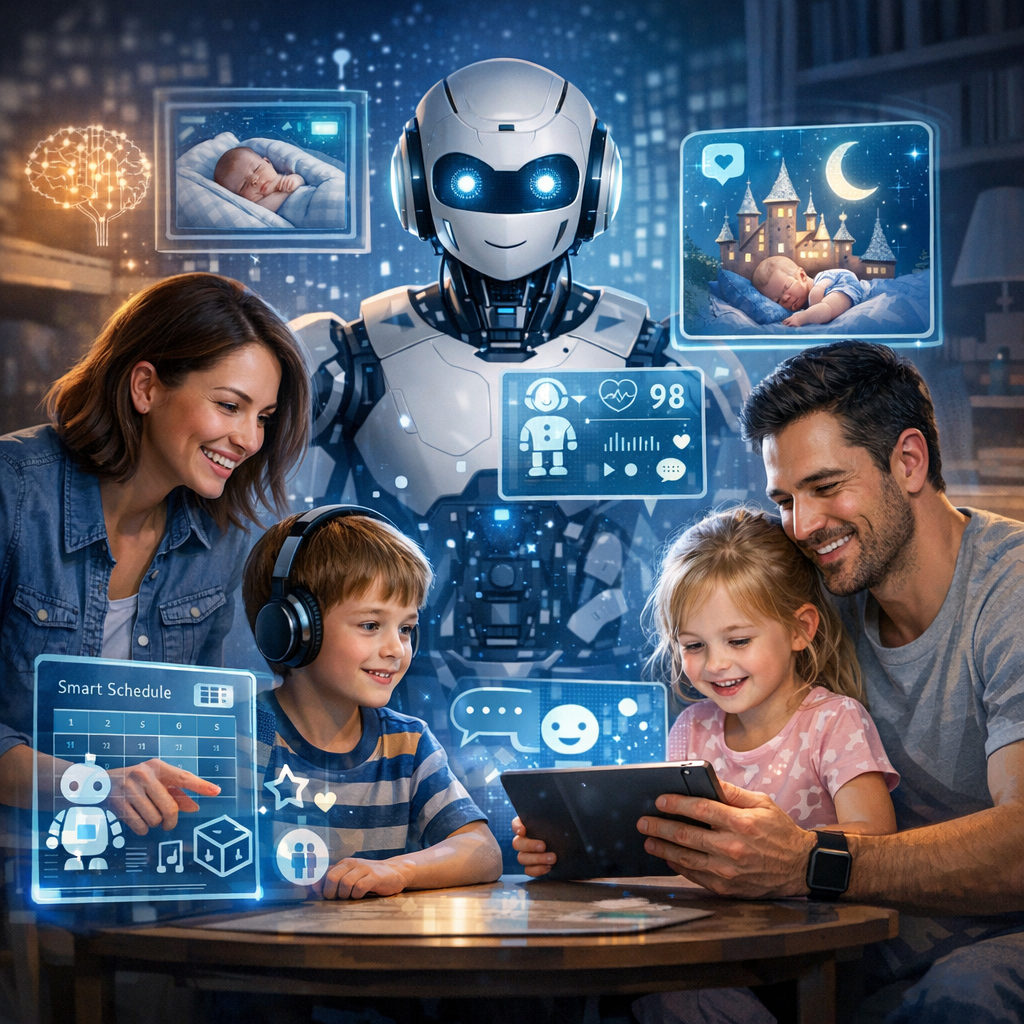
From advanced monitoring systems and personalized educational platforms to intelligent toys and virtual assistants, AI technologies are reshaping the day-to-day dynamics of family life. These innovations provide insights that help parents understand their children’s developmental needs with unprecedented clarity. Moreover, AI can tailor learning experiences that enhance cognitive and emotional growth, identify potential health concerns before they manifest, and even streamline household management tasks.
Beyond the simplification of routine chores, AI fosters a data-driven approach to parenting, offering analytics and feedback that empower parents to make informed choices. By leveraging AI, parents can ensure they provide an environment that adapts to the evolving needs and interests of their offspring. As a result, AI not only supports parents in their immediate objective of raising well-rounded individuals but also contributes to long-term goals by identifying and nurturing unique talents and aptitudes.
For those with resources, utilizing AI in parenting is not merely about convenience; it is about capitalizing on a strategic advantage that enriches their children’s upbringing. As we move further into the digital age, understanding AI’s potential in parenting becomes vital for those invested in providing their children with every conceivable benefit. The question is no longer whether AI can aid parenting but how best to integrate it into a family’s daily life strategically and effectively.
Features
Recent studies have shown that AI’s integration into parenting can result in tangible benefits, enhancing the development and well-being of children. For instance, [a research study conducted by the Massachusetts Institute of Technology](https://www.media.mit.edu/projects/affective-learning-companions/overview/) has highlighted how AI-driven educational tools can accelerate learning and improve kids’ engagement. These tools adapt to a child’s learning pace and offer personalized challenges that encourage intellectual curiosity. This tailored approach not only boosts academic performance but also reinforces a child’s passion for learning.
Moreover, AI’s potential to inform healthcare decisions is profound. [A study published in the Journal of Pediatric Health Care](https://www.jpedhc.org/article/S0891-5245(20)30547-1/fulltext) explored using AI algorithms to monitor children’s health trends and predict potential medical issues. These systems can effectively track vital statistics and recognize anomalies that may indicate underlying health problems, leading to early intervention and reduced hospital visits. Such predictive capabilities are especially beneficial to parents desiring proactive, rather than reactive, healthcare.
In the realm of cognitive and emotional development, AI toys equipped with machine learning capabilities can engage children in meaningful play. As evidenced by [a study from Stanford University](https://www.stanford.edu/research/cognitive-toys/), interactive AI toys can adapt to the emotional and developmental stage of a child, providing companionship that fosters social and emotional intelligence. By responding to emotional cues and encouraging empathetic interaction, these toys contribute to a child’s holistic growth in ways conventional toys cannot.
A critical advantage AI brings to modern parenting is stress reduction through home automation. Systems that manage and streamline daily household tasks, including meal planning, inventory management, and scheduling, free up valuable time for parents. [A Princeton University study](https://www.princeton.edu/main/news/archive/S50/89/51C74/index.xml) affirms that such systems contribute significantly to lowering stress levels among parents, allowing them to spend more quality time with their children and focus on essential parenting tasks.
These professional and medical studies underscore the transformative power of AI in parenting, illustrating its capacity to enhance learning experiences, elevate health monitoring, and facilitate emotional and cognitive development. As AI continues to evolve, so too will its applications in enhancing family dynamics and providing strategic parenting advantages.
Conclusion
Integrating AI into parenting offers a unique opportunity for parents to optimize their approach, providing enriched experiences and strategic advantages for their children’s development. As technology advances, the potential for AI to revolutionize parenting becomes increasingly evident, guiding families toward more informed, efficient, and fulfilling practices. By embracing these innovations, parents not only prepare their children for a future enriched by technology but also create an environment where nurturing and growth occur seamlessly.
References
– [MIT Study on AI in Education](https://www.media.mit.edu/projects/affective-learning-companions/overview/)
– [Journal of Pediatric Health Care article on AI in child healthcare](https://www.jpedhc.org/article/S0891-5245(20)30547-1/fulltext)
– [Stanford University research on AI in cognitive development](https://www.stanford.edu/research/cognitive-toys/)
– [Princeton University study on AI and stress reduction in parenting](https://www.princeton.edu/main/news/archive/S50/89/51C74/index.xml)
“`

Dominic E. is a passionate filmmaker navigating the exciting intersection of art and science. By day, he delves into the complexities of the human body as a full-time medical writer, meticulously translating intricate medical concepts into accessible and engaging narratives. By night, he explores the boundless realm of cinematic storytelling, crafting narratives that evoke emotion and challenge perspectives. Film Student and Full-time Medical Writer for ContentVendor.com