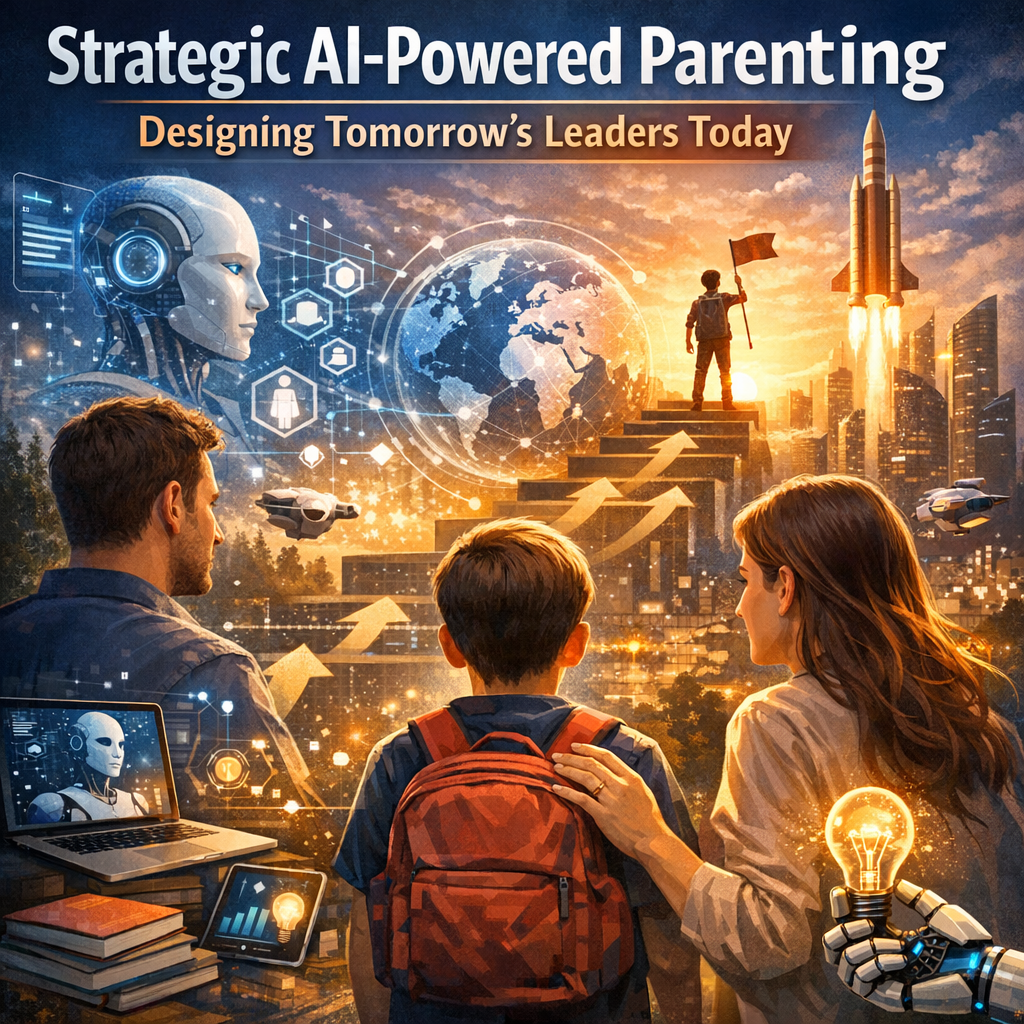
Strategic AI-Powered Parenting: Designing Tomorrow’s Leaders Today
In our increasingly technological world, the emphasis on nurturing the next generation into tech-savvy leaders is no longer a futuristic concept—it’s a present-day necessity. As AI (Artificial Intelligence) continues to redefine boundaries and capabilities across sectors, integrating this powerful tool into parenting strategies can forge pathways to crafting future-ready leaders. For parents of means, investing in AI-powered parenting strategies isn’t just an option; it’s an opportunity to instill leadership qualities while adapting to a rapidly evolving digital era.
Growing up today is remarkably different from how it was just a few decades ago. The digital-native Gen Z and subsequent generations are bombarded with technology, shaping their cognition, learning, and interaction. Utilizing AI technologies in parenting can illuminate pathways for guiding children through digital complexity, cultivating skills that are not just desirable but essential for tomorrow’s leaders.
AI’s potential in parenting spans across adaptive learning, emotional intelligence, and cognitive development enhancements. AI-driven educational platforms can track a child’s learning needs in real-time, personalizing educational content to foster a growth mindset and resilience—traits fundamental to leadership. Furthermore, AI’s role is expanding into emotional intelligence realms, with AI tools offering insights into a child’s mood and helping parents nurture a balanced emotional quotient (EQ). EQ is as vital as IQ for future leaders, enabling empathy, collaboration, and effective communication in a multicultural world.
Experimentation with machine learning models can also assist in identifying a child’s strengths and interests at an early stage. This personalized insight supports parents in strategically supporting their child’s natural inclinations and passions, subsequently nurturing potential leaders by channeling their energies effectively.
Features of AI-Powered Parenting
A growing body of professional and medical research underscores the transformative potential of AI in education and cognitive development. The Educational Data Mining and Learning Analytics community, for instance, emphasizes how AI can optimize educational content by adapting to each learner’s unique needs. Studies reveal that personalized learning through AI can enhance academic performance and promote deeper engagement, crucial for honing analytical and problem-solving skills in future leaders. [Study on Adaptive Learning Systems](https://link.springer.com/article/10.1007/s11423-019-09692-1)
The World Economic Forum points to AI’s capability to imbue a curriculum with future-oriented skills, advocating for an educational overhaul that incorporates technology to teach critical thinking, creativity, and emotional intelligence. By integrating AI, educators and parents can design learning pathways that stimulate not just academic proficiency but also leadership skills, moral values, and ethical reasoning. [World Economic Forum on Future Skills](https://www.weforum.org/reports/the-future-of-jobs-report-2020)
Medical studies also highlight AI’s positive impact on psychological and emotional development in children. AI innovations provide insights into emotional health, identifying emotional triggers and patterns for constructive intervention. This enables parents to foster an environment of emotional safety and growth—key components of a healthy leadership mindset. By using AI to decode psychological patterns, parents can tailor their approach to emotional nurturing, teaching children how to manage stress and build resilience. [AI in Emotional Development](https://www.sciencedirect.com/science/article/pii/S2590005620300205)
Conclusion
Integrating AI into parenting isn’t about replacing the irreplaceable human touch but enhancing it. With strategic implementation, AI can equip parents with the tools to raise well-rounded, emotionally intelligent, and tech-savvy leaders. As parents leverage AI’s insights and capabilities, they lay a robust foundation for their children to not just navigate but lead in the intricate world of tomorrow.
By embracing AI-powered strategies, parents of means can become pioneers in crafting a future where children are not just participants but leaders driving progress and transformation.

Dominic E. is a passionate filmmaker navigating the exciting intersection of art and science. By day, he delves into the complexities of the human body as a full-time medical writer, meticulously translating intricate medical concepts into accessible and engaging narratives. By night, he explores the boundless realm of cinematic storytelling, crafting narratives that evoke emotion and challenge perspectives. Film Student and Full-time Medical Writer for ContentVendor.com