Redefining Parenting: Harnessing Space Tourism to Revolutionize Child Development
Introduction
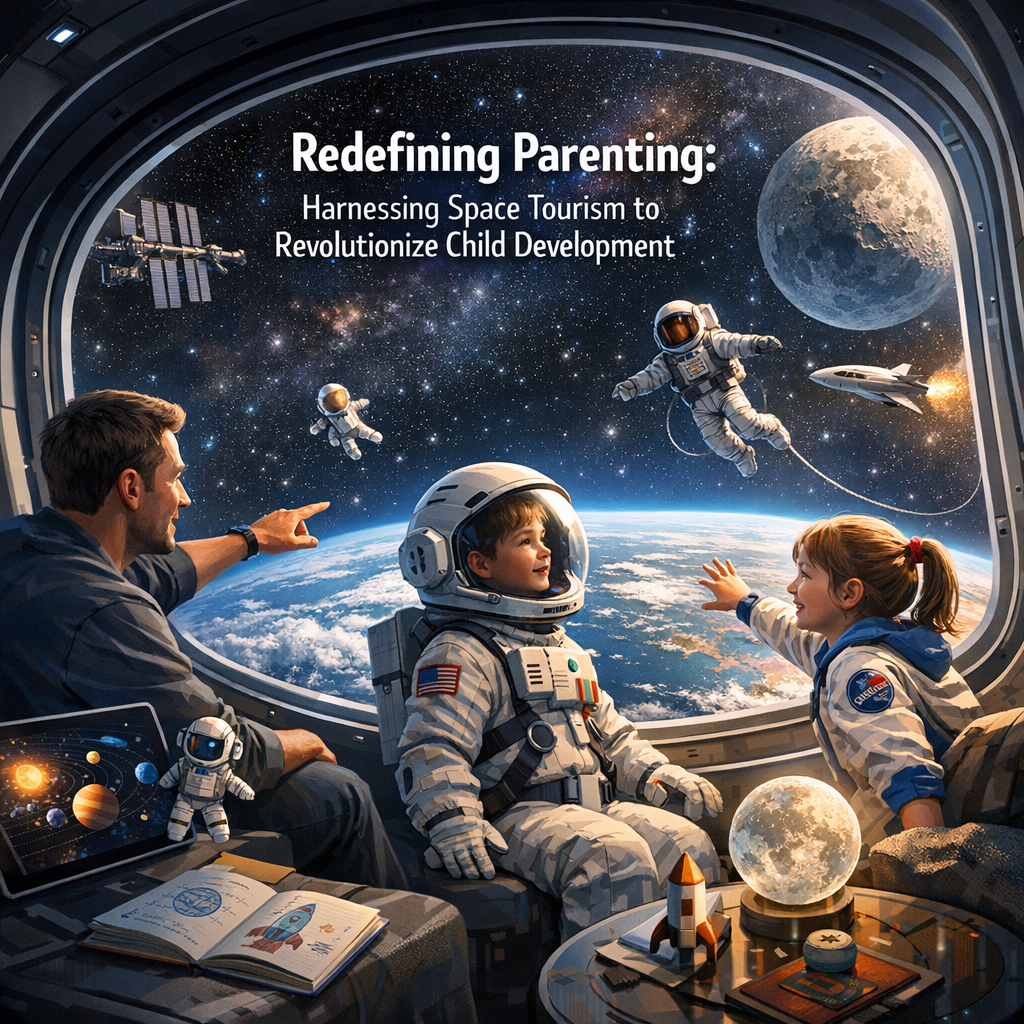
In the ever-evolving landscape of parenting, where innovation and novel experiences are becoming paramount, space tourism emerges as a transformative force poised to revolutionize child development. As we stand on the cusp of a new era of interstellar exploration, the opportunity to redefine parenting through space tourism presents itself as an intriguing possibility for parents of means. The promise of space travel offers more than just an adventure; it provides a unique environment that could alter the trajectory of cognitive, social, and emotional growth in children.
Imagine the impact of weightlessness, the mesmerizing view of Earth from orbit, and the exploration of uncharted terrains on a child’s burgeoning intellect and imagination. The tangible experience of space brings abstract scientific concepts to life, seeding curiosity and inspiring a lifelong love for STEM (Science, Technology, Engineering, and Mathematics). In a world where screens often act as intermediaries to knowledge, the firsthand experience of space could be an unprecedented educational tool.
Beyond the astounding visual and intellectual stimuli, the psychological impact of space travel could be profound. Children exposed to such experiences might develop heightened problem-solving skills, resilience, and adaptability – traits of immense value in an unpredictable future on Earth. Moreover, the collaborative nature of space missions could instill teamwork, communication, and leadership qualities in young minds, fostering holistic development.
Given the potential monumental benefits, the discussion around space tourism as a parenting strategy is both timely and essential. Are we ready to embrace a paradigm where outer space becomes a playground for our progeny? As the industry gains momentum with companies like SpaceX and Blue Origin paving the way, there is a compelling argument that integrating space travel into child development strategies could provide the ultimate luxury: an unparalleled edge in life skills and learning.
Features
Research in the field of neuroscience underscores the importance of novel stimuli in fostering neuroplasticity – the brain’s ability to reorganize itself by forming new neural connections. According to a [study by the National Institute of Health (NIH)](https://www.nih.gov), novel experiences are crucial during childhood as they can significantly influence brain growth and cognitive development. This premise gains new dimensions in the context of space tourism, which presents the ultimate novel experience.
Children’s encounters with unique environments have been shown to enhance problem-solving skills and adaptive thinking. A [Harvard University study](https://www.harvard.edu) on experiential learning revealed that engaging with unfamiliar contexts can enhance critical thinking and innovation, skills imperative in the 21st century. Space tourism, by its very nature, offers an ultimate unfamiliar context, bound to stimulate a young explorer’s mind in ways conventional experiences cannot.
The physiological impact of space travel on developing bodies is an area of ongoing research, but initial studies provide promising insights. For instance, a [report by NASA](https://www.nasa.gov) indicates that space travel could lead to increased bone density and muscle strength over time, given the rigors of the space environment. Exposing children to such conditions, under controlled guidance and safety measures, could potentially offer physical developmental benefits alongside cognitive ones.
Additionally, the psychological benefits tied to viewing Earth from space – often resulting in the ”Overview Effect” – are highly documented, including increased feelings of interconnectedness and environmental responsibility. As children witness the fragility of our planet firsthand, they may develop a deeper understanding and empathy towards global issues, fostering a generation more attuned to conservation and sustainability.
Conclusion
Space tourism stands on the frontier of redefining child development, offering an unparalleled opportunity for experiential learning and holistic growth. As professionals continue to explore its potential benefits, it is imperative for parents of means to consider space as an innovative tool in their parenting strategies. By doing so, they are not only indulging their children in a unique luxury but are also investing in their development as globally conscious and intellectually empowered individuals.
References:
– National Institute of Health (NIH): [https://www.nih.gov](https://www.nih.gov)
– Harvard University: [https://www.harvard.edu](https://www.harvard.edu)
– NASA: [https://www.nasa.gov](https://www.nasa.gov)

Dominic E. is a passionate filmmaker navigating the exciting intersection of art and science. By day, he delves into the complexities of the human body as a full-time medical writer, meticulously translating intricate medical concepts into accessible and engaging narratives. By night, he explores the boundless realm of cinematic storytelling, crafting narratives that evoke emotion and challenge perspectives. Film Student and Full-time Medical Writer for ContentVendor.com