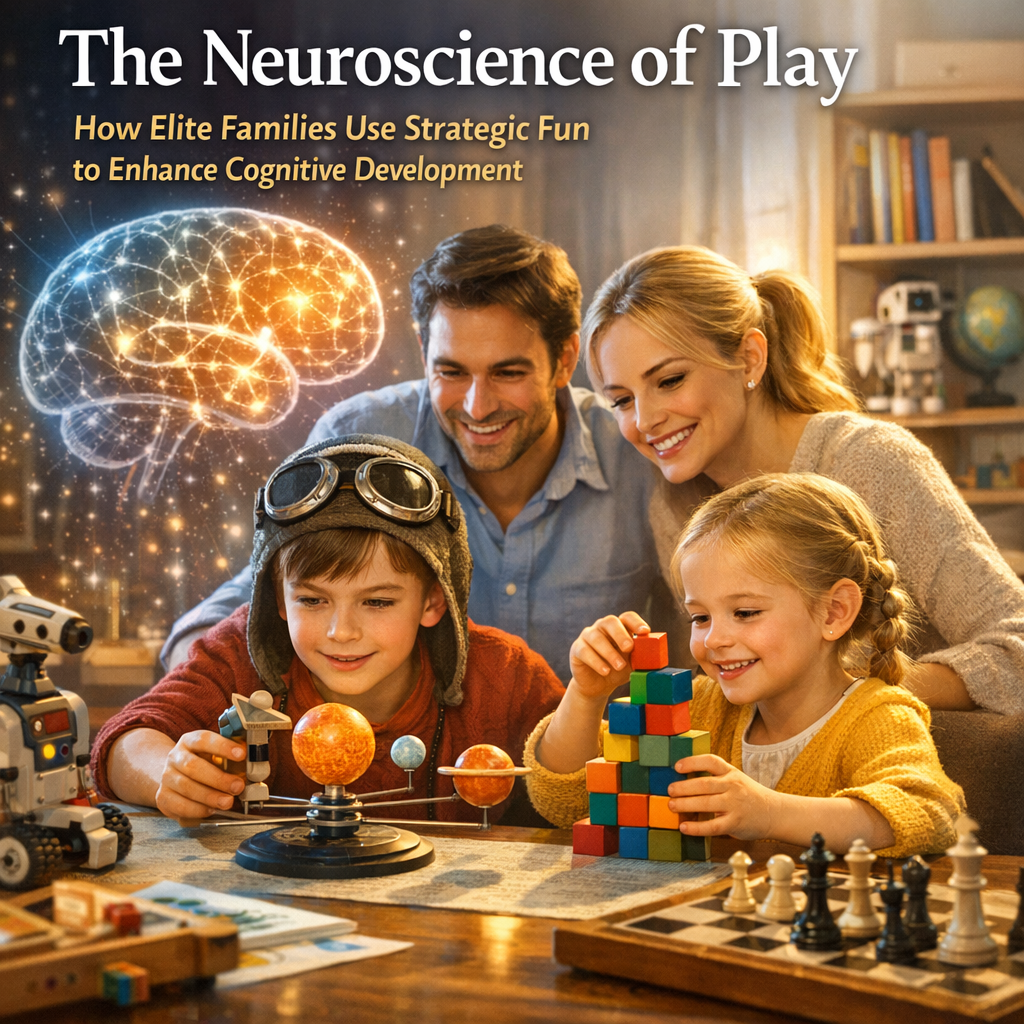
The Neuroscience of Play: How Elite Families Use Strategic Fun to Enhance Cognitive Development
Introduction
In today’s fast-paced world, ensuring the optimal cognitive development of children is a nuanced journey. Among elite families, where resources and opportunities are abundant, there is a particular emphasis on not only providing the best educational tools and environments but also on understanding the profound role of play in fostering brain development. This strategic fun extends beyond mere entertainment and is rooted in the fascinating realm of neuroscience.
Play is not just a leisurely activity but a complex stimulus that has a tangible impact on neural pathways. The science behind play highlights its essential role in fostering cognitive abilities such as problem-solving, memory, and social skills. It serves as a catalyst for brain development, honing both the intellectual and emotional intelligence of children. The concept of using play strategically is not a novel idea, but one that has gained increased attention among elite families who recognize the significance of a play-based approach to learning and development.
For affluent parents who value intellect and innovation, understanding the connection between play and cognitive development can provide an edge. Strategic incorporation of play encourages creative thinking and resilience, both critical for success in today’s dynamic world. Luxurious playrooms equipped with the latest interactive technologies, personalized learning experiences, and bespoke educational toys are increasingly becoming a standard.
This targeted approach to play often involves collaboration with child development experts to ensure that activities are not only enjoyable but also maximize cognitive growth. With advances in neuroscience, parents can now make informed choices about the types of play that will produce measurable benefits in brain function. Elite families engage in informed decision-making to curate play experiences that are aligned with developmental milestones. As such, play becomes a strategic tool to enhance learning potential and emotional well-being, setting a foundation for lifelong success.
Features
Scientific studies shed light on the importance of play in cognitive development, with numerous experts attesting to the benefits of strategically engaging children in play activities. A pivotal study conducted by Dr. Sergio Pellis and his colleagues at the University of Lethbridge in Canada demonstrates how play contributes to the building of the prefrontal cortex, which is crucial for executive functions such as decision-making, social interaction, and emotional regulation [source](https://www.ncbi.nlm.nih.gov/pmc/articles/PMC3214916/).
Additionally, research from Peter Gray, a research professor at Boston College, emphasizes that free play is essential for developing a well-rounded individual. This type of play allows children to engage in activities without rigid structure, promoting creativity and socialization, both of which are significant contributors to cognitive growth [source](https://www.ncbi.nlm.nih.gov/pmc/articles/PMC4065690/).
In the realm of luxury play, elite families often turn to customized play experiences that incorporate the latest technology and pedagogical techniques. For instance, immersive virtual environments can simulate real-world scenarios, providing a platform for children to develop problem-solving skills and adaptability in a controlled yet dynamic way. A study published in the Journal of Applied Developmental Psychology highlights how interactive play environments can significantly enhance peer collaboration and communication skills [source](https://www.sciencedirect.com/science/article/abs/pii/S019339731500163X).
Moreover, toys that encourage coding, engineering, and critical thinking are increasingly sought after, reflecting a growing recognition of their role in supporting STEM learning from a young age. Tools like programmable robots and interactive science kits offer hands-on problem-solving experiences, fostering not only cognitive skills but also an enduring interest in technological advancements [source](https://www.cell.com/trends/cognitive-sciences/fulltext/S1364-6613(10)00290-9).
Ultimately, elite families view play as a multifaceted tool that supports robust cognitive development. By investing in expert guidance and sophisticated resources, they create environments where strategic fun equates to enhanced learning and development, ensuring their children are well-prepared for future challenges.
Conclusion
In conclusion, the integration of strategic play in the developmental journey of children provides a powerful blend of fun and learning, particularly among elite families. By leveraging insights from neuroscience, these families are not only enhancing cognitive development but are also imbuing their children with skills necessary for thriving in an increasingly complex world. With a well-rounded approach to play, children can harness the full potential of their growth, setting the stage for personal and professional success in the future.

Dominic E. is a passionate filmmaker navigating the exciting intersection of art and science. By day, he delves into the complexities of the human body as a full-time medical writer, meticulously translating intricate medical concepts into accessible and engaging narratives. By night, he explores the boundless realm of cinematic storytelling, crafting narratives that evoke emotion and challenge perspectives. Film Student and Full-time Medical Writer for ContentVendor.com