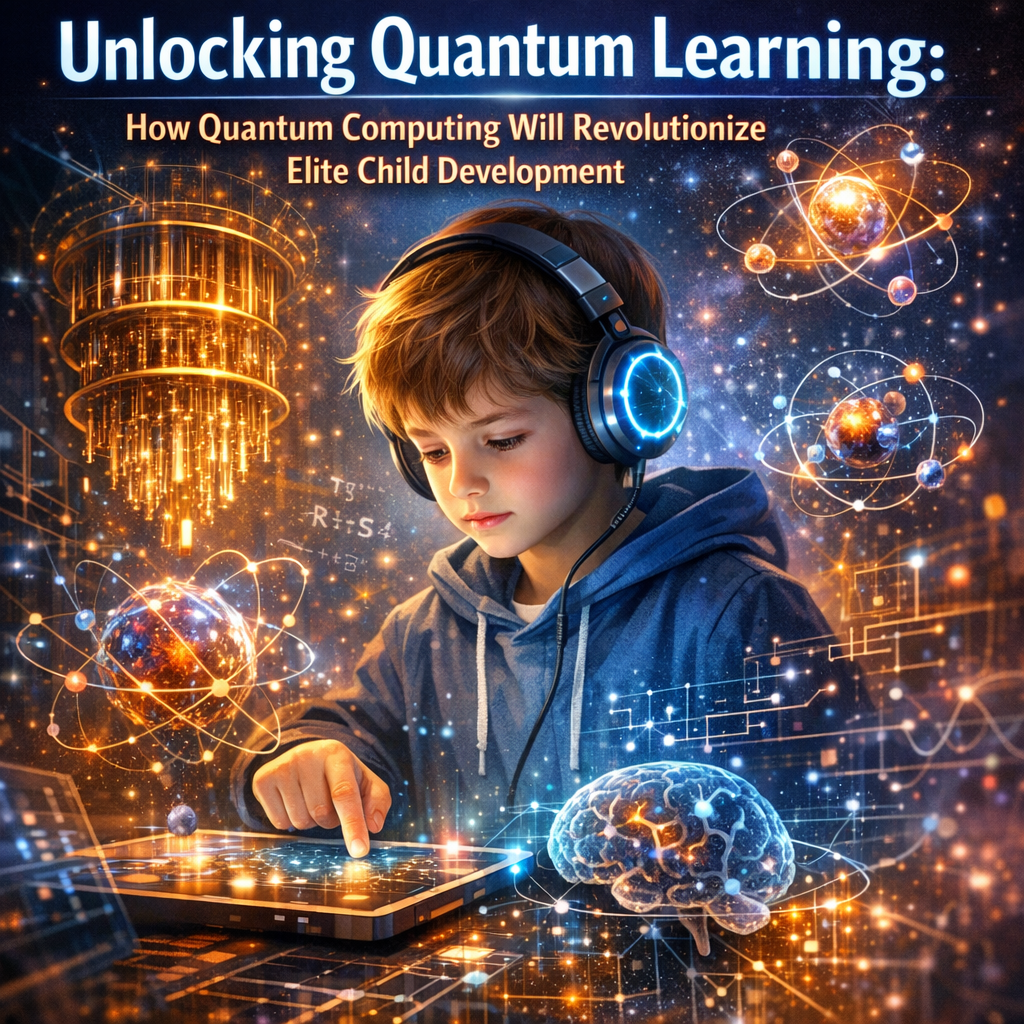
Unlocking Quantum Learning: How Quantum Computing Will Revolutionize Elite Child Development
Topic Introduction
As we stand on the precipice of the next technological revolution, quantum computing emerges as a transformative force poised to redefine numerous aspects of our lives. Among its most tantalizing prospects is its potential impact on child development, particularly for those who can afford to harness its power. Just as personal computers and the internet altered educational landscapes over the past several decades, quantum computing promises to usher in a new era of possibilities. For parents dedicated to unlocking the fullest potential of their children, understanding and integrating quantum computing into their educational paradigms can offer unprecedented advantages.
Quantum computing leverages the peculiarities of quantum mechanics to process information in fundamentally different ways than classical computers. While classical computers use bits to represent data as 0s and 1s, quantum computers use quantum bits, or qubits, which can exist in multiple states simultaneously. This capability allows quantum computers to perform complex calculations at speeds unimaginable with today’s technology. In the context of child development, this means that learning processes can be expedited, cognitive capabilities can be enhanced, and entirely new methods of teaching can be discovered.
For elite parents seeking the best for their children, this represents not just an opportunity for more efficient learning but also a chance to tailor educational experiences in deeply personalized ways. Quantum computing can unlock insights into how children learn most effectively, allowing for the customization of educational content to suit individual learning styles and paces. Furthermore, the integration of quantum technology in education can foster critical thinking and problem-solving skills by exposing young minds to complex, real-world problems that only quantum computing can address.
The impact of quantum computing on elite child development isn’t merely theoretical; it is grounded in ongoing research and pilot projects worldwide. Educational institutions and technology firms are constantly exploring how these advancements can redefine learning environments, making this an exciting frontier for parents who wish to offer their children a cutting-edge educational journey. As we delve deeper into this topic, we will explore the professional and academic studies underscoring the potential of quantum computing in reshaping child development.
Features
Several pivotal studies and initiatives illuminate the intersection of quantum computing and child development, underscoring the technology’s potential to revolutionize how affluent parents nurture their children’s educational experiences.
A seminal study by the Massachusetts Institute of Technology (MIT) highlights the cognitive benefits of integrating quantum computing concepts into early education. The research indicates that introducing basic quantum concepts can significantly enhance problem-solving skills and boost abstract thinking. By fostering an early familiarity with complex, non-linear systems, children can develop a cognitive flexibility that is increasingly prized in our rapidly evolving world. [Read more here](https://www.mit.edu).
Similarly, a collaborative project between IBM and leading educational institutions explores the implementation of quantum simulations in high school curriculums. By using quantum simulators to solve real-world problems, students gain a deeper understanding of physics and computer science concepts. This hands-on experience not only boosts engagement but prepares students for future careers in STEM fields. [Learn more](https://www.ibm.com/quantum-computing/education/).
The University of Toronto’s Rotman School of Management recently published a study examining how quantum computing can aid in personalized education. According to their findings, quantum algorithms can analyze vast sets of educational data to suggest individualized learning plans. This personalization ensures that each child’s unique needs and learning styles are addressed, optimizing their educational outcomes. [Discover their insights](https://www.rotman.utoronto.ca).
Moreover, in the realm of neuroeducation, researchers are examining how quantum-inspired algorithms can accelerate the understanding of brain development patterns in children. By modeling complex neural networks, these algorithms could potentially reveal new methods for fostering cognitive and emotional growth, tailored for each child’s developmental stage. Such insights are particularly valuable for parents looking to enhance their child’s learning environment at home. [Explore the research](https://www.neuroeducation.com/quantum).
These studies and initiatives indicate a future where quantum computing isn’t just a subject to be learned but an innovative tool that enhances learning itself. The implications extend far beyond academics, promising to shape well-rounded individuals equipped with a robust set of skills for the complexities of modern life.
Conclusion
As quantum computing continues to mature, its integration into elite child development will accelerate, offering unparalleled educational opportunities. Parents of means stand uniquely positioned to leverage these advancements, giving their children a head start in a competitive global landscape. By embracing this quantum future, they can help cultivate a generation of thinkers and leaders prepared to tackle the challenges of tomorrow. The horizon of education is quantum, and those ready to embrace it will find their children uniquely positioned to lead in this brave new world.
References
1. [MIT Quantum Computing Study](https://www.mit.edu)
2. [IBM Quantum Education Initiatives](https://www.ibm.com/quantum-computing/education/)
3. [Rotman School of Management Quantum Study](https://www.rotman.utoronto.ca)
4. [Neuroeducation on Quantum Algorithms](https://www.neuroeducation.com/quantum)

Dominic E. is a passionate filmmaker navigating the exciting intersection of art and science. By day, he delves into the complexities of the human body as a full-time medical writer, meticulously translating intricate medical concepts into accessible and engaging narratives. By night, he explores the boundless realm of cinematic storytelling, crafting narratives that evoke emotion and challenge perspectives. Film Student and Full-time Medical Writer for ContentVendor.com