When Elite Parenting Meets AI: Crafting Your Child’s Future Without the Stress
Introduction
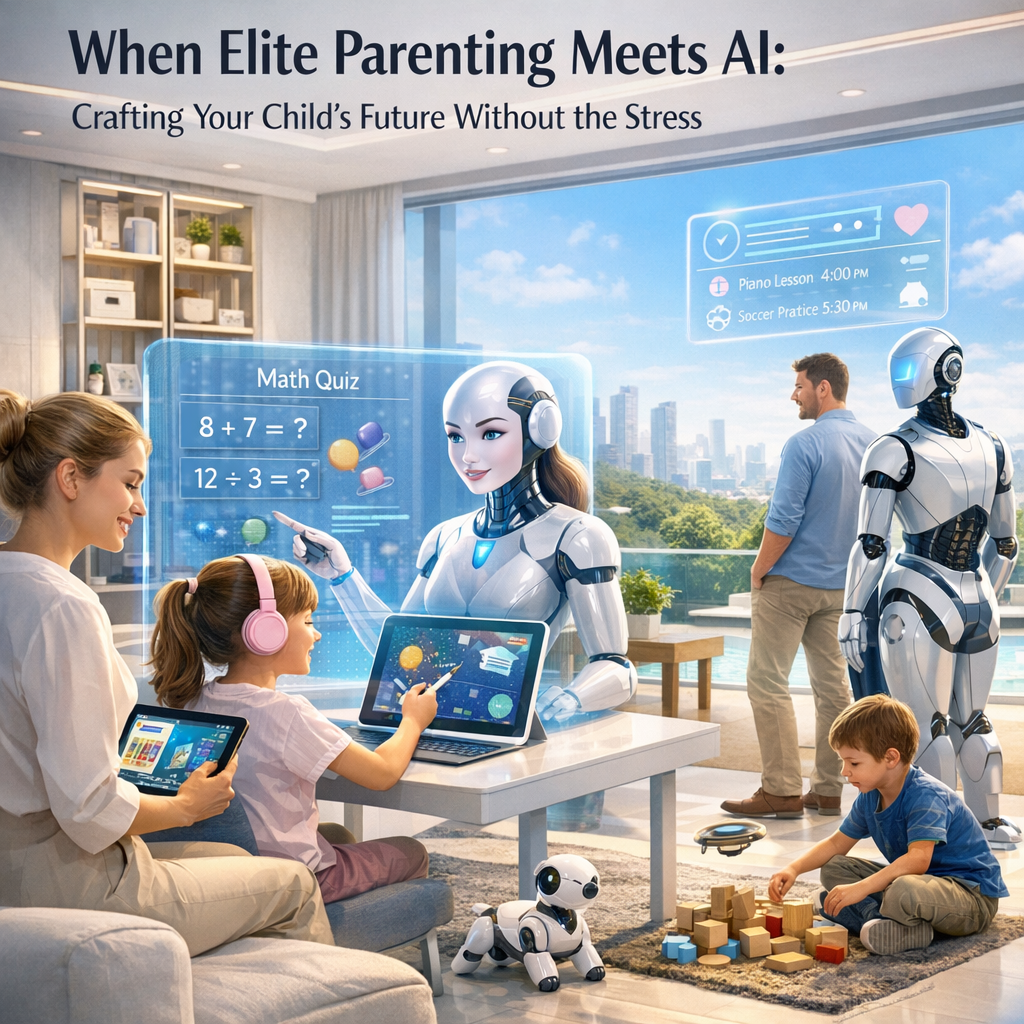
In the ever-evolving landscape of modern parenting, the demands placed upon parents of means continue to grow. Raising a child today involves juggling a wide array of expectations, from ensuring academic excellence to nurturing emotional intelligence and creativity. For elite parents, who have the resources and vision to provide the very best for their children, this is no small feat. Enter the world of artificial intelligence (AI), a technological advancement poised to revolutionize the way we approach parenting.
AI is not merely a futuristic novelty but a powerful tool that can offer personalized learning experiences, safety solutions, and health monitoring tailored specifically to a child’s unique needs. By leveraging AI, parents can make informed decisions, optimize their child’s development, and ensure safety, all while reducing the inherent stress associated with parenting. It offers the possibility to track developmental milestones, predict and address educational challenges before they arise, and even design bespoke learning plans that cater to a child’s distinct preferences and abilities.
For elite parents, the intersection of AI and parenting presents an opportunity to cultivate an environment that fosters both exceptional academic and personal growth. With AI-driven insights into cognitive and emotional development, parents are equipped with unprecedented capabilities to guide their children on the path to success. At the same time, they can maintain a balanced and stress-free family life, as AI can manage a number of routine tasks and provide predictive analytics that preemptively address potential concerns.
Yet embracing AI in parenting is not without its considerations. Elite parents must remain cognizant of privacy implications, ethical concerns, and the importance of maintaining the irreplaceable human touch in parenting. As such, a discerning approach is crucial: leveraging AI judiciously to enhance, not replace, the valuable human interactions that form the cornerstone of a child’s upbringing.
Features
Professional and medical studies underscore the potential of AI in transforming elite parenting. A study by the World Economic Forum highlights the transformative role AI can play in personalized education. AI platforms can assess a child’s learning style and adjust educational content accordingly, fostering improved engagement and comprehension in young learners. The use of AI in creating personalized educational pathways is supported by research from Stanford University, which emphasizes its efficacy in meeting individual learning paces and interests, ultimately fostering a more profound and lasting educational impact ([source](https://www.weforum.org): World Economic Forum, [source](https://www.stanford.edu): Stanford University).
Moreover, AI’s application in health monitoring offers significant advancements in pediatric care. According to a study published in the Journal of Medical Internet Research, AI-driven health trackers provide real-time data on a child’s physical activities, sleep patterns, and even stress levels. These AI tools offer actionable insights and timely interventions, enabling parents to optimize their child’s well-being and mitigate health risks. Such technological advancements herald a new era in personalized child healthcare, where data-driven decision-making can enhance physical, mental, and emotional health outcomes ([source](https://www.jmir.org): Journal of Medical Internet Research).
Ethics and privacy remain at the forefront of integrating AI into parenting practices. The Children’s Online Privacy Protection Act (COPPA) explores the legal frameworks ensuring data privacy for minors, prompting AI developers to design systems that prioritize safeguarding children’s rights. This sets a precedent for ethically-conscious AI applications, promoting practices that preserve privacy and emphasize trust between technology providers and families ([source](https://www.ftc.gov): COPPA).
With these insights supported by reputable studies, elite parents can confidently embrace AI’s potential to refine their parenting strategies. However, it is imperative to cultivate a balance that combines technological innovation with human empathy and intuition—ensuring that all facets of a child’s development receive the nurturing and attention they deserve.
Conclusion
As the capabilities of AI continue to advance, the opportunities it presents for elite parenting are undeniably transformative. By intelligently leveraging AI, parents can mitigate stress, craft personalized development pathways, and safeguard their child’s health with unprecedented precision. In this journey, embracing technological innovation must be harmonized with the human commitment to ethical considerations and preserving the essence of parental love and guidance. The future of parenting, where AI meets affluence, promises not only to ease the journey but to elevate it to new heights of potential and fulfillment for both parent and child.
1. [World Economic Forum: Transforming Education with AI](https://www.weforum.org)
2. [Stanford University Research: AI in Education](https://www.stanford.edu)
3. [Journal of Medical Internet Research: AI in Healthcare Monitoring](https://www.jmir.org)
4. [The Children’s Online Privacy Protection Act (COPPA)](https://www.ftc.gov)

Dominic E. is a passionate filmmaker navigating the exciting intersection of art and science. By day, he delves into the complexities of the human body as a full-time medical writer, meticulously translating intricate medical concepts into accessible and engaging narratives. By night, he explores the boundless realm of cinematic storytelling, crafting narratives that evoke emotion and challenge perspectives. Film Student and Full-time Medical Writer for ContentVendor.com