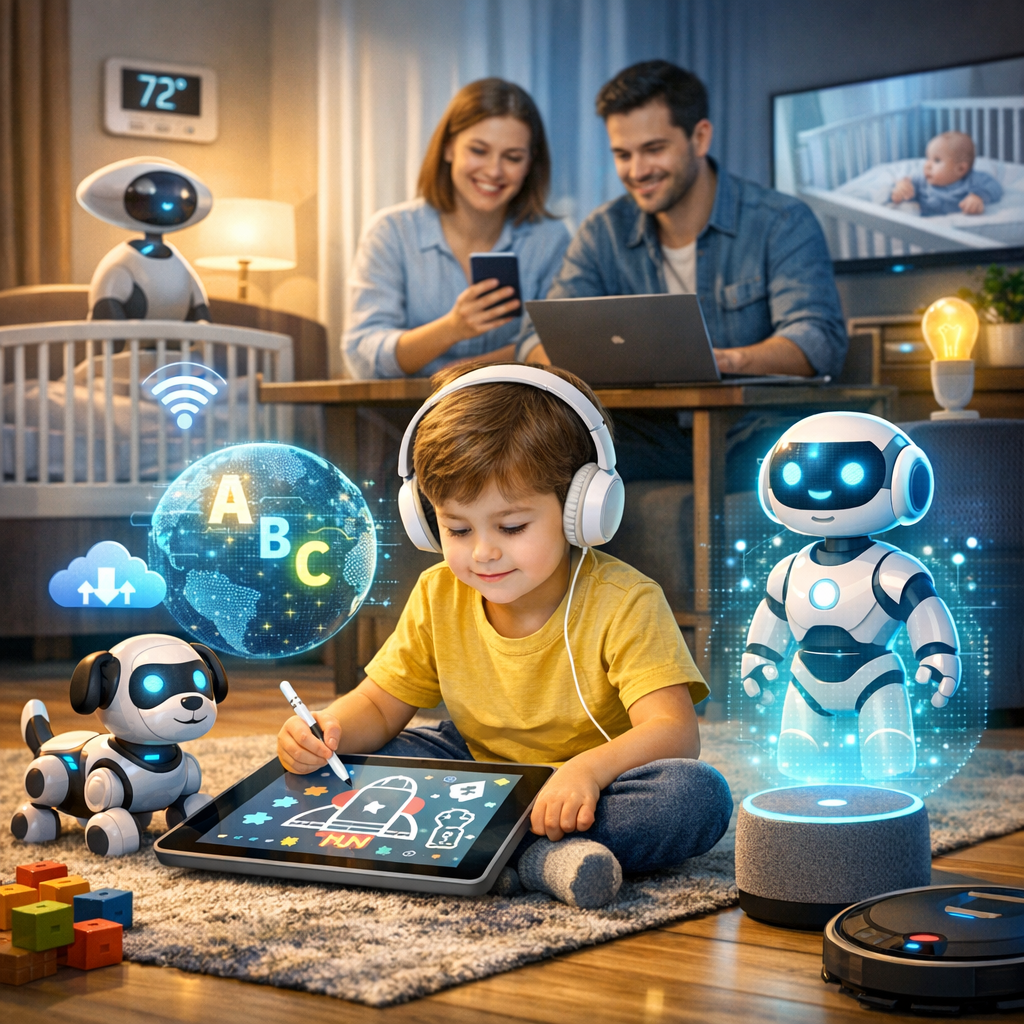
High-Tech Parenting: The Future of Child Development in a Fully Integrated Smart Home
Introduction
In today’s rapidly evolving digital age, technology is not just a part of our lives; it is the very fabric that weaves everyday experiences together. For parents in the realm of luxury, staying ahead of technological advancements is not just a lifestyle choice, but a responsibility to equip their offspring with tools that will prepare them for the future. Enter the fully integrated smart home—a paradigm shift in parenting where the fusion of technology and living spaces comes together to craft an enriched environment tailored for child development.
As parents, we are naturally inclined to nurture, protect, and mold our children into the well-rounded individuals they are destined to become. With the advent of smart home technologies, this objective transitions from mere aspiration to attainable reality. Imagine a home where intelligent sensors intuitively adjust the environment to match the developmental needs of a child. Ambient lighting can be tailored to stimulate creativity, cognitive functions, or relaxation, all while interactive education systems provide customized learning experiences designed for each child’s unique learning pathway. By harnessing these sophisticated technologies, smart homes can provide a controlled and enriched environment catering not just to the physical, but equally to the intellectual and emotional development of children.
Consider the progressive strides made with artificial intelligence, augmented reality, and smart devices; these tools can create a rich tapestry of immersive experiences that can endow young minds with the ability to engage in a truly interactive learning ecosystem. Additionally, smart home technologies offer unparalleled safety and security features. From state-of-the-art monitoring systems that provide real-time data on a child’s developmental milestones, to intelligent home assistants facilitating parental control remotely—these innovations pave the way for a new era where responsive parenting is guided by cutting-edge technology.
Features
Various professional and medical studies have explored the implications of smart technology on child development, offering parents a well-founded rationale to embrace these innovations. According to a study published in the journal [*Pediatrics*](https://pediatrics.aappublications.org/), children who engage with interactive media—when monitored and guided by guardians—demonstrate improved problem-solving skills and cognitive growth. Moreover, the [American Academy of Pediatrics](https://pediatrics.aappublications.org/) emphasizes the importance of media mentorship, suggesting that parental engagement with technology aids in building critical thinking alongside media literacy skills in children.
Another landmark study from the [National Association for the Education of Young Children](https://www.naeyc.org/) indicates that technology, when used appropriately, can enrich a child’s education by amplifying learning methodologies that are already effective. By incorporating smart interactive systems akin to augmented reality games or application-based learning programs, children can explore scientific concepts or historical eras through virtual simulations, offering a hands-on learning experience without leaving their homes.
Additionally, advances in health technology within smart homes are particularly promising. Monitoring devices can track developmental milestones and alert parents to potential concerns before they become critical. As per research carried out by the [NHS](https://www.nhs.uk/live-well/), incorporating connected health devices within a smart home can reduce instances of childhood obesity and encourage healthy habits. Wearable tech and smart scales, for example, provide feedback on physical activities and nutritional intake, allowing parents to tailor lifestyle changes in real-time.
However, with great technological advancement comes the need for balance. The [World Health Organization](https://www.who.int/) has emphasized responsible technology usage, advocating for mealtimes and unscheduled family interaction as technology-free zones to encourage relationship building and communication skills. By maintaining such a balance, parents can harness the potential of smart technologies while ensuring comprehensive holistic growth for their children.
Conclusion
As we stand on the brink of what is undeniably a technologically driven era, the smart home emerges as the next frontier of parenting, redefining how children learn, play, and grow. These homes not only provide innovative solutions for nurturing child development but do so in a manner that promises safety and convenience, allowing for a harmonious blend of security and exploration. As guardians of a new generation, it is our enterprise to mold adaptive, tech-savvy citizens who will thrive in a digital economy, with the smart home acting as the foundation for educated, well-rounded individuals equipped for every challenge the future may hold.
References
1. [American Academy of Pediatrics – Media and Young Minds](https://pediatrics.aappublications.org/)
2. [National Association for the Education of Young Children – Technology and Interactive Media](https://www.naeyc.org/)
3. [National Health Service – Healthy Living and Technology](https://www.nhs.uk/live-well/)
4. [World Health Organization – Guidelines on Physical Activity, Sedentary Behaviour and Sleep for Children Under 5 Years of Age](https://www.who.int/)

Dominic E. is a passionate filmmaker navigating the exciting intersection of art and science. By day, he delves into the complexities of the human body as a full-time medical writer, meticulously translating intricate medical concepts into accessible and engaging narratives. By night, he explores the boundless realm of cinematic storytelling, crafting narratives that evoke emotion and challenge perspectives. Film Student and Full-time Medical Writer for ContentVendor.com