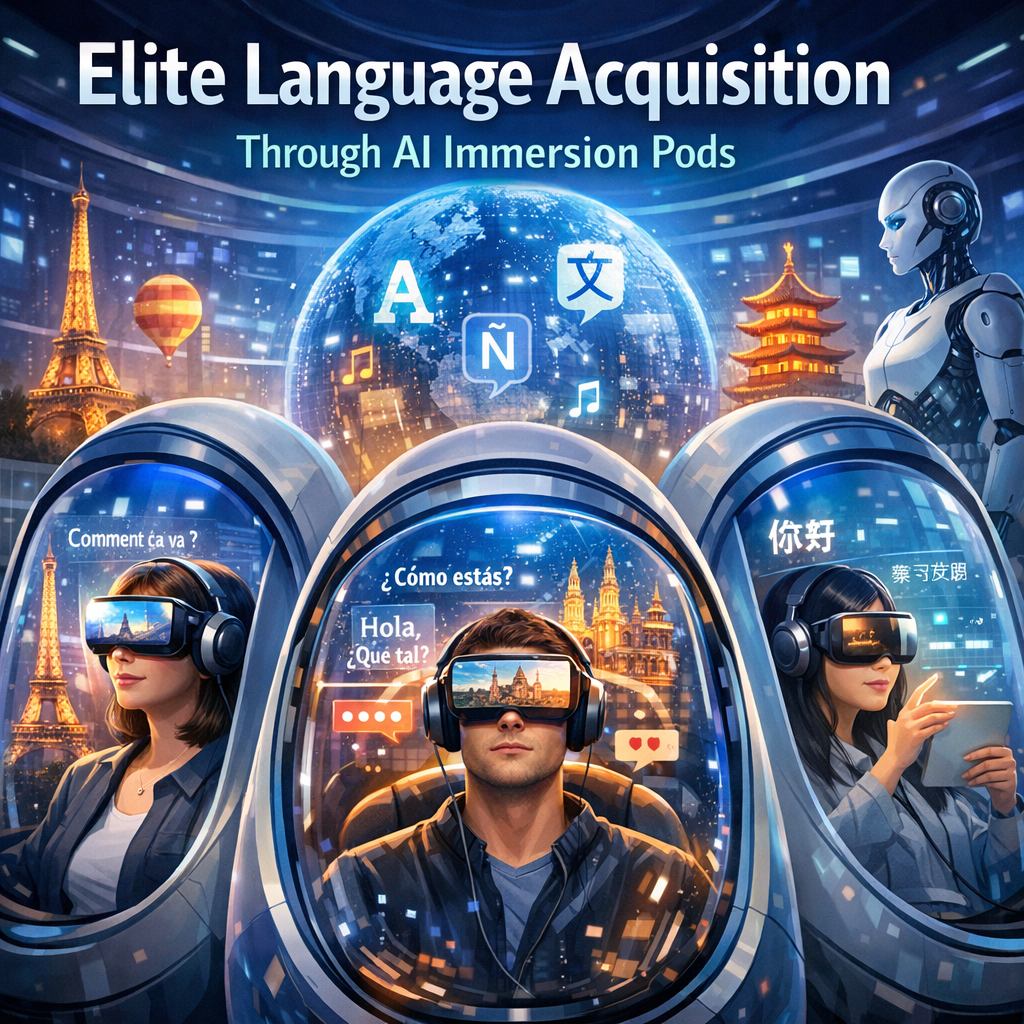
Elite Language Acquisition Through AI Immersion Pods
Introduction:
In today’s globalized society, the ability to speak multiple languages is increasingly seen as a marker of sophistication and cultural literacy. For affluent families, providing children with access to elite language acquisition tools is not just a luxury, but a strategic advantage. Such tools prepare them for a future likely defined by international connectivity and cross-cultural interactions. One of the most innovative advances in this realm is the concept of AI Immersion Pods—personalized language learning environments powered by artificial intelligence.
At a glance, AI Immersion Pods might sound like a concept from science fiction. However, these state-of-the-art learning modules are rapidly becoming a reality, unveiling a disruptive educational approach tailored to meet the needs of children from wealthy backgrounds. Unlike conventional language classes, AI Immersion Pods promise an interactive and engaging atmosphere that mimics the experience of living in a foreign linguistic environment. This immersive setting enables children to acquire a new language as naturally as they learned their native tongue.
The core of this innovation lies in its use of machine learning algorithms capable of analyzing individual learning patterns. These AI systems can adapt in real-time to a child’s responses, pace, and comprehension level, optimizing the teaching strategy and material accordingly. Furthermore, the multisensory experience offered by these pods—through audio, visual, and even tactile interfaces—ensures that children remain captivated during the learning process, maximizing retention and fluency.
Parents looking to provide their children with the finest education understand the importance of early language acquisition, supported by numerous studies indicating that children have greater neural plasticity for language learning compared to adults. The integration of AI and language acquisition offers a futuristic solution, preparing young learners to seamlessly navigate a multilingual world.
Features:
Research into language acquisition and neural development among children has established the critical period hypothesis, suggesting there is an optimal time window for acquiring language skills. During this period, typically from birth until the onset of puberty, the brain is highly receptive to language learning. Studies, such as those conducted by Dr. Patricia Kuhl at the University of Washington, have demonstrated that children are natural language learners, and their brains are exquisitely designed to absorb linguistic nuances from their environment. By utilizing this natural capacity through AI Immersion Pods, children can experience enhanced fluency and cognitive growth.
The innovative framework of these pods is rooted in the latest AI learning technologies. Research studies aimed at understanding the efficiency of human-computer interactive learning, like those published in journals such as the Journal of Educational Computing Research, illustrate AI-based adaptive learning systems improve engagement and outcomes by providing instantaneous feedback and personalized learning trajectories.
Furthermore, a study published in the International Journal of Artificial Intelligence in Education highlights the efficacy of immersive learning environments. The findings suggest that such environments significantly bolster language retention and speaking proficiency by simulating real-life conversational contexts. Importantly, AI Immersion Pods blend this pedagogically sound practice with the customizable depth that only advanced AI systems can provide. The pods simulate environments ranging from bustling marketplaces to serene park settings, all filled with native speakers and culturally relevant sounds, thereby enriching the learning experience.
Medical insights also highlight that engaging multiple senses in the learning process, a principle applied within the pods, enhances neuron connectivity and memory. According to research in the *Trends in Cognitive Sciences* journal, multisensory learning aids in developing the brain’s executive functions, inclusive of linguistic skills. This type of engagement helps accelerate the development of language-related neural pathways, reinforcing the benefits of early immersion in a linguistic environment.
Conclusion:
AI Immersion Pods represent a groundbreaking leap in the realm of elite language education by merging cutting-edge artificial intelligence with proven linguistic pedagogy. For parents seeking the pinnacle of language acquisition for their children, these pods offer more than just a futuristic educational tool—they provide a gateway to a richer, more interconnected global perspective. By investing in such innovative technologies, affluent families can offer their children a profound competitive edge, equipping them with the linguistic proficiency and cultural fluency needed to thrive in a rapidly evolving world.
References:
1. [Kuhl, P. K. (2011). Early language learning and literacy: Neuroscience implications for education. *Mind, Brain, and Education*, 5(3), 128-142.](https://onlinelibrary.wiley.com/doi/10.1111/j.1751-228X.2011.01121.x)
2. [Lin, H., and Li, J.Y. (2020). AI tools in language learning: Current research and advanced design. *Journal of Educational Computing Research*.](https://journals.sagepub.com/home/jec)
3. [Dede, C. (2009). Immersive interfaces for engagement and learning. *Science*, 323(5910), 66-69.](https://www.sciencemag.org)
4. [Shams, L., and Seitz, A. R. (2008). Benefits of multisensory learning. *Trends in Cognitive Sciences*, 12(11), 411-417.](https://www.cell.com/trends/cognitive-sciences)

Dominic E. is a passionate filmmaker navigating the exciting intersection of art and science. By day, he delves into the complexities of the human body as a full-time medical writer, meticulously translating intricate medical concepts into accessible and engaging narratives. By night, he explores the boundless realm of cinematic storytelling, crafting narratives that evoke emotion and challenge perspectives. Film Student and Full-time Medical Writer for ContentVendor.com