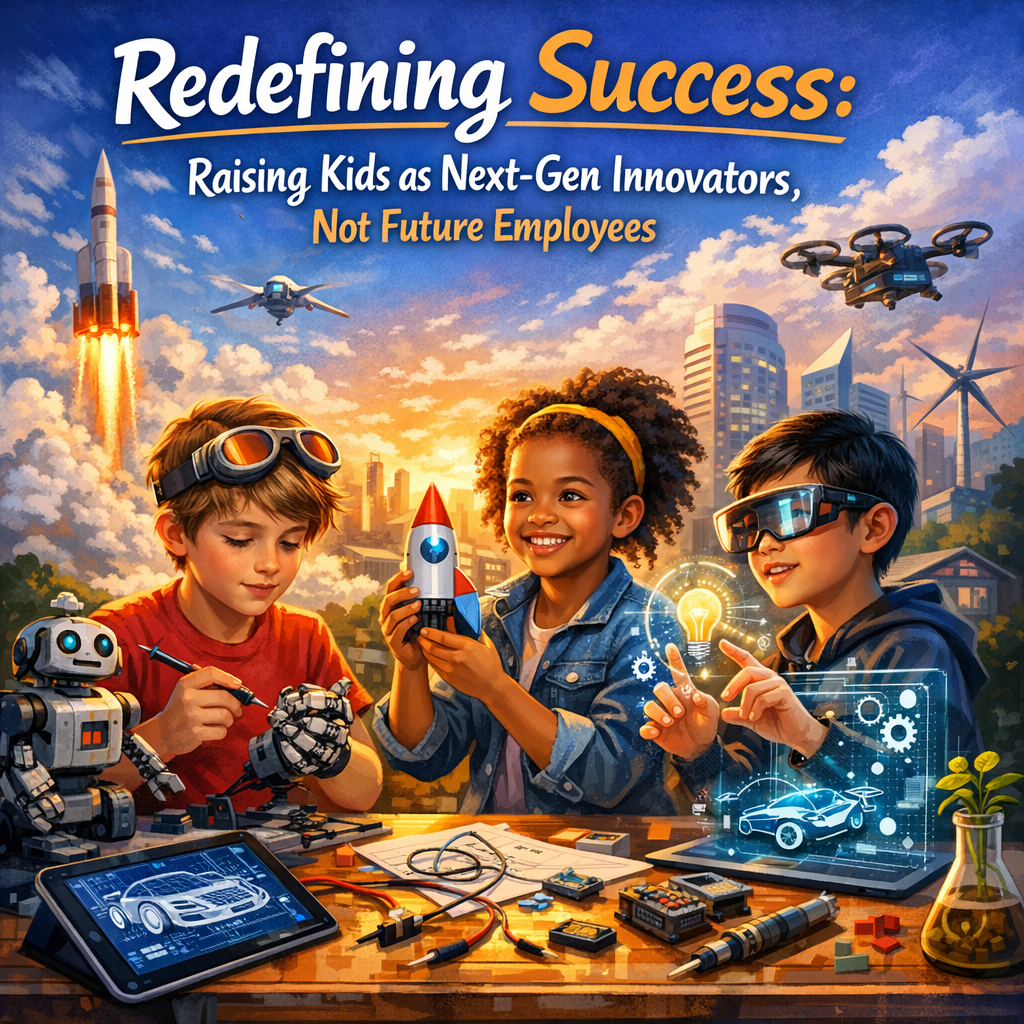
Redefining Success: Raising Kids as Next-Gen Innovators, Not Future Employees
In today’s rapidly evolving world, the conventional blueprint for success is being reimagined. For parents, particularly those of significant means, nurturing the next generation of thinkers and leaders presents an opportunity to redefine what it means to be successful. The traditional career trajectory—education, secure job, and steady promotions—is being dismantled by the ever-changing landscape of technology and innovation. As the future becomes increasingly unpredictable, raising children to be adaptive innovators rather than mere future employees is paramount.
The 21st century demands a different breed of leaders who are not only tech-savvy but also imaginative and versatile. Today’s children need to be equipped with the skills to think creatively and independently, embrace uncertainty, and continually adapt to new challenges. Terms like ’entrepreneurial spirit’, ’innovative thinking’, and ’disruptive leadership’ are becoming buzzwords in the world of education and parenting. However, nurturing these qualities in kids involves more than just enrolling them in the best schools or programs. It requires a fundamental shift in parenting philosophies and techniques.
High-net-worth parents are in a unique position to provide their children with experiences and resources that can foster this entrepreneurial mindset. The ability to fund unique educational pursuits, expose children to diverse cultures, and provide hands-on learning experiences can be significant advantages. However, it is also essential to focus on instilling the right values—a love for learning, resilience in the face of failure, and the courage to pursue the unknown.
Moreover, as parents, redefining success for the next generation involves introspection into their definitions of achievement and fulfillment. As the guardians of yet-to-be-formed legacies, they must consider what it truly means to prepare their children not just to fit into existing paradigms but to reshape them. By shifting attention from structured, predetermined paths to fostering an environment where curiosity and creativity can thrive, parents pave the way for their children to become the innovators the world needs.
Features: Professional and Medical Studies on Innovative Development
Recent studies in developmental psychology and education highlight the importance of fostering creative and innovative thinking in children. According to research conducted by [Harvard University](https://www.harvard.edu), programs that emphasize creative play and problem-solving have a profound impact on cognitive development. This is particularly relevant as these cognitive skills form the foundation for innovation and adaptability later in life.
Moreover, a [Stanford University](https://www.stanford.edu) study revealed that students exposed to design thinking—a methodology that encourages iterative learning and creative problem-solving—performed better in both academic and entrepreneurial settings. They were found to be more resilient and capable of handling complex problems—traits essential for succeeding in unpredictable environments.
Another significant body of research from the [Massachusetts Institute of Technology (MIT)](https://www.mit.edu) found that when children are encouraged to explore and interact with their environment in a constructive way, their ability to think outside the box increases. This aligns with the idea that children should be viewed as future innovators rather than future employees, focusing on creativity and application rather than rote memorization and standardization.
Additionally, a white paper published by the [World Economic Forum](https://www.weforum.org) emphasized the need for educational frameworks that go beyond STEM learning to include emotional intelligence, critical reasoning, and leadership skills. It highlights the importance of teaching children how to learn, think critically, and communicate effectively in nurturing innovative spirit.
By understanding these studies, parents can better create environments that promote the intellectual agility and emotional stability required for innovation. Emphasizing play, exploration, and independent thought can significantly contribute to raising children who are prepared to challenge norms and innovate for change.
Conclusion
In the quest to redefine success for the next generation, it is crucial to move beyond the concept of creating future employees. Instead, by nurturing creativity, resilience, and a love for continuous learning, parents can raise the next wave of innovators ready to shape the world. Through intentional parenting and exposure to enriching experiences, children can be empowered to become change-makers who redefine what it means to succeed in a constantly changing world. As we embrace this shift, we prepare our children not just for the jobs of tomorrow, but to create the futures they envision.
References
1. [Harvard University](https://www.harvard.edu)
2. [Stanford University](https://www.stanford.edu)
3. [Massachusetts Institute of Technology (MIT)](https://www.mit.edu)
4. [World Economic Forum](https://www.weforum.org)

Dominic E. is a passionate filmmaker navigating the exciting intersection of art and science. By day, he delves into the complexities of the human body as a full-time medical writer, meticulously translating intricate medical concepts into accessible and engaging narratives. By night, he explores the boundless realm of cinematic storytelling, crafting narratives that evoke emotion and challenge perspectives. Film Student and Full-time Medical Writer for ContentVendor.com