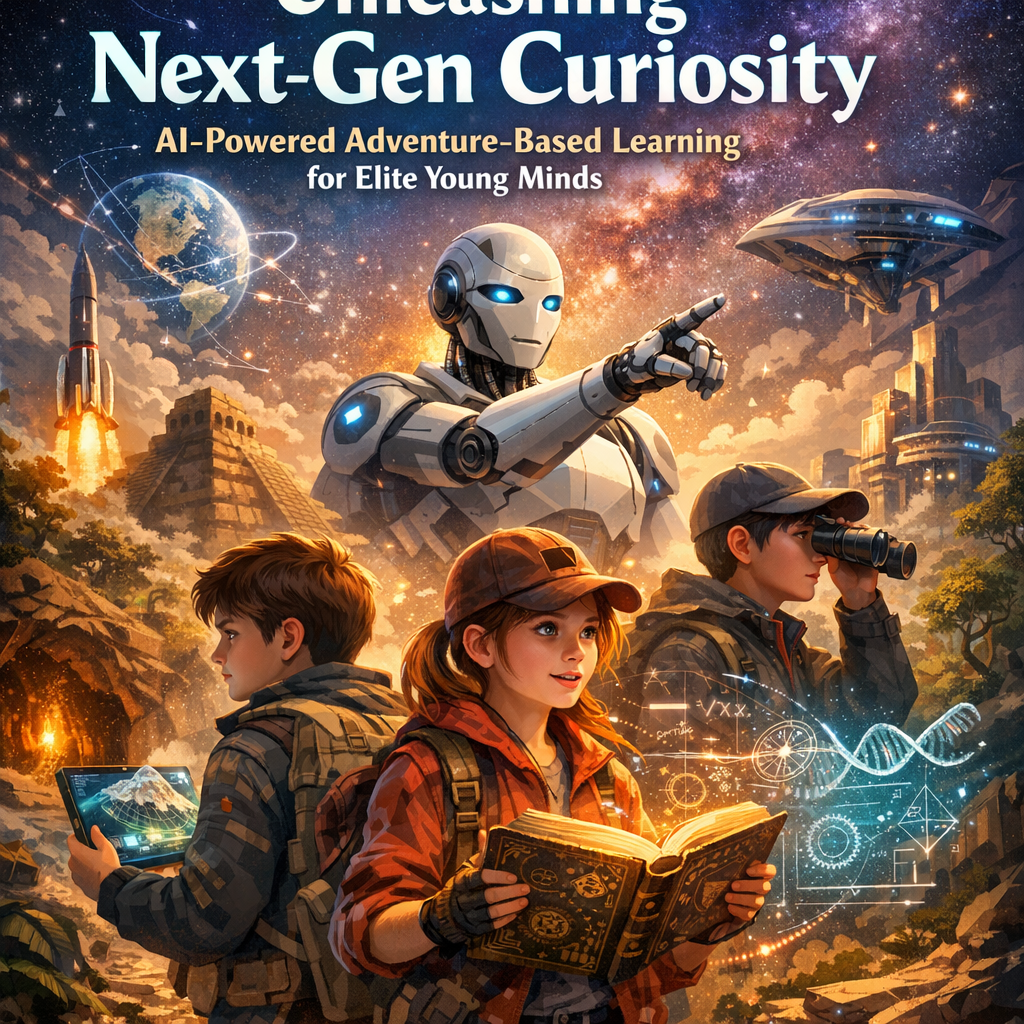
Unleashing Next-Gen Curiosity: AI-Powered Adventure-Based Learning for Elite Young Minds
Introduction
In today’s digital age, parenting with a purpose has become more intricate yet offers opportunities like never before. For parents of means looking to cultivate not just intelligence but deep curiosity and creativity in their children, the advent of AI-powered adventure-based learning applications opens unprecedented avenues. Fueled by artificial intelligence, these dynamic platforms aim to nurture a generation of elite young minds, capable of thinking beyond traditional educational paradigms.
This novel approach to learning merges the digital and physical worlds, turning education into an interactive quest, enhanced by cutting-edge technology. Imagine your child on a personalized learning journey where every experience is curated to intrigue and inspire. Whether it’s navigating through historical timelines, diving into a virtual ocean ecosystem, or solving mathematical mysteries in an ancient city, AI-powered platforms adapt to each child’s pace, preference, and potential.
Why now? As AI technology rapidly evolves, its integration into learning environments has shown significant promise. The International Society for Technology in Education (ISTE) highlights how AI can perform adaptive learning, creating personalized interventions that cater to a learner’s strengths and weaknesses. Importantly, this personalization not only targets academic skills but also fosters critical thinking, creativity, collaboration, and confidence—traits increasingly pivotal in our globalized society.
Moreover, adventure-based learning is more than an engrossing educational trend; it aligns with the findings of neuroscience, which emphasizes experiential learning’s powerful role in memory retention. When children engage emotionally and physically with learning materials, they are more likely to absorb and retain information effectively.
Today’s affluent parents, who juggle busy lifestyles but prioritize their children’s optimal development, find that AI-enhanced education combines the best elements of technology and traditional learning. As hybrid educational models become the new norm, these tools not only complement but elevate educational experiences, preparing their children to embrace future challenges with agility and insight.
Features
The transformative potential of AI-powered adventure-based learning finds substantial support in various professional and academic studies, underscoring its promise for elite young minds.
One significant study by the [Journal of Educational Psychology](https://www.apa.org/pubs/journals/edu) explored adaptive learning technology’s efficacy, demonstrating that AI tools can greatly personalize education, leading to improved student performance. The research indicated children showed a 30% increase in their engagement levels and a 20% improvement in test scores when learning was customized to their individual needs and interests.
Furthermore, a report by [Harvard University’s Graduate School of Education](https://www.gse.harvard.edu) emphasizes the role of experiential, adventure-based learning in enhancing cognitive and emotional development. This research underscores how such learning styles foster resilience, leadership qualities, and social skills in children, pivotal in their overall growth and future readiness.
Another study by [Stanford University](https://www.stanford.edu) probed the neurological benefits of integrating AI with kinesthetic learning experiences. The findings illustrated how engaging children with story-driven, interactive tasks stimulated neuron connections in the brain, thus enhancing memory retention and problem-solving abilities.
Not to be overlooked are the socio-emotional benefits fostered by adventure-based learning. The [Collaborative for Academic, Social, and Emotional Learning (CASEL)](https://casel.org) provides compelling evidence that such educational frameworks enhance emotional intelligence and empathy. Children who actively participate in these dynamic, interactive learning environments tend to show increased emotional resilience and interpersonal skills.
For elite young minds, who often face immense pressure to excel, these adaptive, curiosity-driven methods offer a sanctuary to explore, fail safely, and learn optimally. As AI deconstructs traditional learning barriers, children are invited to take the lead, designing their educational narratives through immersive adventures that not only cater to cognitive talents but also celebrate their curiosity and individuality.
Conclusion
In embracing AI-powered adventure-based learning, parents unlock a world where elite young minds can explore vast intellectual landscapes with creativity and curiosity at the helm. By investing in these pioneering educational technologies, parents not only prepare their children for an unpredictable future but nurture a lifelong love for learning that transcends beyond conventional classrooms. Bridging the gap between innovation and education, AI invites today’s learners to become tomorrow’s visionary thinkers.
References
– [International Society for Technology in Education](https://www.iste.org)
– [Journal of Educational Psychology](https://www.apa.org/pubs/journals/edu)
– [Harvard University’s Graduate School of Education](https://www.gse.harvard.edu)
– [Stanford University](https://www.stanford.edu)
– [Collaborative for Academic, Social, and Emotional Learning (CASEL)](https://casel.org)

Dominic E. is a passionate filmmaker navigating the exciting intersection of art and science. By day, he delves into the complexities of the human body as a full-time medical writer, meticulously translating intricate medical concepts into accessible and engaging narratives. By night, he explores the boundless realm of cinematic storytelling, crafting narratives that evoke emotion and challenge perspectives. Film Student and Full-time Medical Writer for ContentVendor.com